<?xml version="1.0" encoding="UTF-8"?>
<?xml-stylesheet type="text/xsl" href="/stylesheets/feed.atom.xml" media="screen"?>
<feed xml:lang="en-US" xmlns="http://www.w3.org/2005/Atom">
  <id>tag:populationanalytics.nd.edu,2005:/news-and-events/news</id>
  <link rel="alternate" type="text/html" href="https://populationanalytics.nd.edu"/>
  <link rel="self" type="application/atom+xml" href="https://populationanalytics.nd.edu/news-and-events/news.atom"/>
  <id>tag:populationanalytics.nd.edu,2005:/latest</id>
  <title>Notre Dame Population Analytics | News</title>
  <updated>2026-07-16T12:59:00-04:00</updated>
  <link rel="alternate" type="text/html" href="https://populationanalytics.nd.edu/"/>
  <link rel="self" type="application/atom+xml" href="https://populationanalytics.nd.edu//news-and-events/news.atom"/>
  <subtitle>Notre Dame Population Analytics (ND Pop) is a multidisciplinary program within the College of Arts &amp; Letters that conducts policy-relevant quantitative research</subtitle>
  <entry>
    <id>tag:populationanalytics.nd.edu,2005:News/183151</id>
    <published>2026-07-16T12:59:00-04:00</published>
    <updated>2026-07-16T12:59:20-04:00</updated>
    <link rel="alternate" type="text/html" href="https://populationanalytics.nd.edu/news-and-events/news/notre-dame-researchers-find-doctors-played-a-critical-role-in-the-nations-opioid-crisis/"/>
    <title>Notre Dame researchers find doctors played a critical role in the nation’s opioid crisis</title>
    <summary type="text">
      <![CDATA[Notre Dame economists William Evans and Ethan Lieber examined the prescription practices of physicians in the late 1990s and found that they had increased the frequency and extent to which they prescribed opioids for treating chronic pain, contributing to the overall increase in opioid use and subsequent overdose deaths across the country.]]>
    </summary>
    <content type="html">
      <![CDATA[<p>The official sum of opioid-related settlements reached between U.S. state and local governments and the major pharmaceutical opioid manufacturers, marketers, distributors and retailers <a href="https://www.opioidsettlementtracker.com/globalsettlementtracker">recently reached the $58.58 billion mark</a>.</p>
<p>Stark statistics from the U.S. Centers for Disease Control and Prevention also indicate that since 1999, approximately 860,000 people have died from an opioid overdose, with nearly 318,000 of those deaths attributable to prescription opioids. In 2024, 73.4 percent of drug overdose deaths were attributable to opioids, with 65.1 percent of those deaths from illegally made fentanyls, <a href="https://www.cdc.gov/overdose-prevention/data-research/facts-stats/sudors-dashboard-fatal-overdose-data-accessible.html">according to the CDC</a>.</p>
<p>While much of the focus of the opioid litigation and public conversation in recent years has been on the role of the pharmaceutical industry and how their advertising campaigns led to an increase in opioid use and subsequent overdose deaths, there is more to the story behind this nationwide catastrophe.</p>
<p>Researchers at the University of Notre Dame found that doctors had a hand in fueling the opioid crisis by aggressively prescribing opioids to treat chronic pain. Their work shows the extent to which doctors’ prescribing practices can be linked to that increase, indicating that if there had not been such a strong push on the part of physicians, opioid-related death rates would have been much lower.</p>
<p>According to <a href="https://economics.nd.edu/people/william-evans/">William Evans</a> and <a href="https://economics.nd.edu/people/ethan-lieber/">Ethan Lieber</a>, both from Notre Dame’s <a href="https://economics.nd.edu/">Department of Economics</a> and co-authors of an <a href="https://jhr.uwpress.org/content/early/2026/01/07/jhr.0724-13685R2">article published in the Journal of Human Resources</a>, physicians began prescribing opioids to treat chronic pain more extensively and more often in the late 1990s. If their prescription practices had stayed at their 1995 levels, there would have been 43 percent fewer deaths by 2015, just two decades later.</p>
<p>The duo’s work has the potential to guide conversations about reeducating doctors on the appropriate use of opioids for pain relief and reframing how medical schools teach future doctors about appropriate prescribing practices.</p>
<figure class="image image-left"><img src="https://news.nd.edu/assets/452140/400x/bill_evans_300x350.jpg" alt="Headshot of Bill Evans with short gray hair and glasses. He wears a light blue button-down shirt and a dark blue and gray striped tie. He is posed against a plain gray background." width="400" height="467">
<figcaption>William Evans is the Keough-Hesburgh Professor of Economics and co-founder of Notre Dame’s Wilson Sheehan Lab for Economic Opportunities, as well as director of Notre Dame Populations Analytics (ND Pop). Photo by Barbara Johnston/University of Notre Dame</figcaption>
</figure>
<p>“Most of the people who have followed this issue acknowledge that the changing prescribing practices of doctors played a critical role in the drug crisis,” said Evans, the Keough-Hesburgh Professor of Economics and co-founder of Notre Dame’s <a href="https://leo.nd.edu/">Wilson Sheehan Lab for Economic Opportunities.</a> “I think we’ve come up with a nice way to quantify the impact, and it is massive.”</p>
<p>To track physicians’ practice of overprescribing opioids as pain medication, Evans and Lieber first examined the county characteristics in 1990 that predicted the surge in drug deaths beginning in the early 2000s. They identified one factor that is particularly predictive for whether the county will eventually have a severe drug poisoning crisis: the fraction of the working age population receiving Social Security Disability Insurance (SSDI).</p>
<p>These benefits are for adults who have worked for a minimum of time in jobs covered by Social Security and who have a medical condition limiting their ability to maintain gainful employment. The co-authors showed that not only are those on SSDI in more pain than average, but those in high SSDI rate geographies also have higher levels of pain. Their work shows that as physicians became more aggressive at treating chronic pain with opioids, these high-SSDI, high-pain areas had, on average, a much more severe drug poisoning crisis.</p>
<p>Historically, opioids had only been prescribed for those post-surgical and cancer patients experiencing acute pain, leaving those with chronic pain untreated. Starting in the mid-1990s, however, there was a reevaluation of the use of opioids to treat chronic pain. In 1995, the co-authors noted, the medical community established the notion that pain was the “fifth vital sign,” specifically measuring pain levels and equating pain relief with quality of care. In that same year, medical experts released a statement advocating the use of opioids for chronic pain relief. As a result, physicians took note and became more aggressive in their prescribing of those drugs.</p>
<p>Using data from the National Ambulatory Medical Care Surveys from 1980 through 2015, Evans and Lieber demonstrated that prior to 1995, only about 7 percent of patients visiting a doctor with a condition likely to generate chronic pain received an opioid prescription. After 1995, this number increased dramatically, reaching 25 percent by 2015.</p>
<figure class="image image-right"><img src="https://news.nd.edu/assets/574024/400x/ethan_m.j._lieber.jpg" alt="Ethan Lieber wears black glasses and smiles warmly while wearing a light blue shirt and dark gray blazer." width="400" height="320">
<figcaption>Ethan Lieber is the Dillon Hall Associate Professor in Notre Dame’s Department of Economics. Photo by Peter Ringenberg/University of Notre Dame</figcaption>
</figure>
<p>“We were struck by how much these numbers changed over time and how the timing coincided with the efforts to encourage greater use of opioids to treat chronic pain,” said Lieber, the Dillon Hall Associate Professor in Notre Dame’s <a href="https://economics.nd.edu/">Department of Economics</a>.</p>
<p>Evans added that the <a href="https://www.painnewsnetwork.org/stories/2016/6/16/ama-drops-pain-as-vital-sign">American Medical Association</a> dropped the use of pain as the fifth vital sign in 2016, noting that “the president of the AMA said at the time that physicians played a key role in the epidemic and now they must do their part to end it.”</p>
<p>The study takes into account other factors that potentially drive drug poisoning death rates such as local economic conditions, general access to health services, the decline of institutions like manufacturing jobs and relationships, the rise and marketing of opioid drugs like OxyContin, and prescription drug monitoring programs.</p>
<p>A key data set in their work was the Drug Enforcement Administration’s Automation of Reports and Consolidated Orders System (ARCOS), which tracks shipments of opioids from manufacturers to points of sale or distribution. Detailed transaction-level data from ARCOS was released as part of the opioid litigation.</p>
<p>In 2024, <a href="https://news.nd.edu/news/notre-dame-develops-comprehensive-public-database-of-nationwide-opioid-transactions/">Notre Dame developed a user-friendly interface</a> of the ARCOS database, which enables public access to more than 10 years of national controlled substance transaction information for 14 different opioids.</p>
<p>This research stems from the <a href="https://populationanalytics.nd.edu/">Notre Dame Population Analytics (ND Pop)</a>, a data-focused research effort fostering and advancing multidisciplinary work on a wide range of pressing demographic issues facing society. Evans leads ND Pop, which is facilitated by a partnership between the University’s <a href="https://strategicframework.nd.edu/initiatives/poverty-initiative/">Poverty Initiative</a> and the <a href="https://al.nd.edu/">College of Arts &amp; Letters</a>.</p>
<p>To hear Evans and Lieber discuss their research, check out the <a href="https://www.hoover.org/research/prescription-disaster-drug-deaths-america">Economics: Applied podcast</a>, hosted by the Hoover Institution.</p>
<p><em><strong>Contact: Tracy DeStazio</strong>, associate director of media relations, 574-631-9958 or <a href="mailto:tdestazi@nd.edu">tdestazi@nd.edu</a></em></p>
<p class="attribution">Originally published by <span class="rel-author">Tracy DeStazio</span> at <span class="rel-source"><a href="https://news.nd.edu/news/notre-dame-researchers-find-doctors-played-a-critical-role-in-the-nations-opioid-crisis/">news.nd.edu</a></span> on <span class="rel-pubdate">July 16, 2026</span>.</p>]]>
    </content>
    <link rel="enclosure" type="image/jpeg" href="https://populationanalytics.nd.edu/assets/666665/istock_1136527900.jpg" title="A hand in a lab coat writes on a prescription pad. Nearby, white pills spill from an overturned bottle; another bottle contains yellow pills."/>
    <author>
      <name>Tracy DeStazio</name>
    </author>
  </entry>
  <entry>
    <id>tag:populationanalytics.nd.edu,2005:News/183438</id>
    <published>2026-06-19T12:00:00-04:00</published>
    <updated>2026-07-30T10:12:44-04:00</updated>
    <link rel="alternate" type="text/html" href="https://populationanalytics.nd.edu/news-and-events/news/psychology-professors-design-cutting-edge-intervention-program-for-families-in-the-west-bank-nd-jerusalem-offers-support/"/>
    <title>Psychology professors design cutting-edge intervention program for Palestinian families</title>
    <summary type="text">
      <![CDATA[Notre Dame faculty are carrying out research all around the globe, year-round. Their research spans continents, connects them with remote parts of the world, and even brings them into war and conflict-torn areas. For some of them, that’s exactly where they need to be. For over a decade, Notre…]]>
    </summary>
    <content type="html">
      <![CDATA[<p>Notre Dame faculty are carrying out research all around the globe, year-round. Their research spans continents, connects them with remote parts of the world, and even brings them into war and conflict-torn areas. For some of them, that’s exactly where they need to be.</p>
<p>For over a decade, Notre Dame psychology professors <a href="https://psychology.nd.edu/people/laura-miller-graff/">Laura Miller-Graff</a> and <a href="https://psychology.nd.edu/people/mark-cummings/">Mark Cummings</a> have been visiting Gaza and the West Bank to do transformational research. The collaboration began when Miller-Graff first began her appointment at Notre Dame in 2013 (though their connection goes back even further—Miller-Graff was an undergraduate in Cummings’ lab). They made an excellent match as collaborators due to their shared interest in the impact of political violence on children.</p>
<p>The resulting joint project from their partnership is <a href="https://globalhealth.nd.edu/research/community-based-program-supports-mental-health-in-palestinian-conflict-region/">Promoting Positive Family Futures</a>—a family-based intervention program for Palestinian parents and their adolescent children to support family wellbeing, communication, and mental health in the context of the ongoing violence that Palestinians experience in their day-to-day lives. Essentially, as Cummings puts it, the program is “designed to strengthen family functioning in the face of stress.”</p>
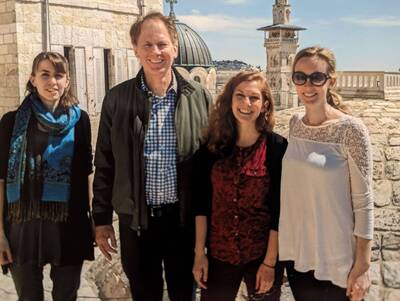
<figure class="image image-right"><img src="https://jerusalem.nd.edu/assets/661591/400x/laura_and_mark_jerusalem.jpeg" alt="Four smiling people outdoors in front of stone buildings, a cross-topped dome, and a minaret-like tower." width="600" height="452">
<figcaption>Mark Cummings and Laura Miller-Graff with two of<br>their graduate students during a trip to Palestine.</figcaption>
</figure>
<p>The research has stretched over 10 years because of the thorough process behind it. Before fully launching their project, Miller-Graff and Cummings spent years carrying out a pilot program, in part supported by a Notre Dame Global grant. They then collected data from the pilot and used their findings to apply for funding to begin the next implementation phase. “We're doing something that I confidently say is world-class work. It's world-class intervention research, cutting edge,” Cummings says. They’ve found outstanding partners in Catholic Relief Services and the Palestinian Counseling Center, and eventually, secured essential funding from the National Institute of Mental Health. “It's been really a great privilege to be able to work with our partners on it and continue to fine-tune it for the families,” Miller-Graff says. This “fine-tuning” is a vital part of their process. As Cummings shares, “We really wanted to contextualize our program for the needs of Palestine.”</p>
<p>One lesson they learned from paying attention to the local audience was the need to reformat their working groups. “The idea was to have mothers, fathers, and children do the program in groups, and then we got our first pilot data back from 25 families,” Cummings says. “This first pilot study was conducted in the West Bank in 2017 in collaboration with the Palestinian Counseling Center. We had great participation by mothers and adolescents (in this first pilot study) but not a single father participated.” Rather than write off fathers as uninterested, they dug deeper and made changes for the second pilot study conducted in Gaza with 62 families (mothers, fathers and adolescent children) supported by Catholic Relief Services (CRS). “We had separate sessions for dads and then one for mothers and adolescents. We tried that because we concluded that it doesn't work in Palestinian culture (based on our West Bank pilot study) to have unrelated men and women together,” Cummings remarks. The outcome for the second pilot study in Gaza in 2019? Participation from fathers jumped drastically—from zero to nearly 100%, including participation in the 8 treatment sessions and pretest, post-test and 6-month follow-up assessments.</p>
<p>The main purpose of their most recent visit, this past year, was to meet the therapists they’d been working with to learn about their experience implementing the program. They also met with some of the families who participated in the program.</p>
<p>“It was really, really beautiful to meet with the families,” Miller-Graff says. “It's been interesting because there's this element of what families agree that they've gotten out of the program as a family, but also each individual member taking away different things according to what their needs were at the time. We've been really happy because it speaks to the program's ability to flexibly meet a diverse set of needs that families might bring, which was really our hope heading into it.”</p>
<p>Cummings speaks of the challenges they faced throughout, particularly in the beginning, as they worked to secure funding and partners. They thought they had ironed out everything and made plans to return to the West Bank and Gaza to finally implement their project. They visited colleagues at the Palestinian Counseling Center in the West Bank in the summer of 2023 but did not visit the Catholic Relief Services site in Gaza. To accomplish a follow-up visit to Gaza, they booked their flights for mid-October of 2023, days after the October 7th attack that would ignite the Israel-Hamas war.</p>
<p>“We had to cancel our plane tickets and close down the Gaza site because of the war,” Cummings shares. Remarkably, they were back up and running a month later, jumping on conference calls with colleagues at CRS and the Palestinian Counseling Center every week, often multiple times a week. Their original goal was to work with 150 families in the West Bank and 150 in Gaza. “After the war started, it was not tenable to continue in Gaza, our partners needed to redirect their resources to lifesaving humanitarian aid,” Miller-Graff says. By December of 2023, they had resumed work in the West Bank, sticking to their goal of serving 300 families.</p>
<p>“It really is a real testament to our partners. It has taken an enormous amount on all sides of careful rethinking about what providers need, how we need to do training differently, how we need to deliver the intervention to families, where we would deliver the intervention to families, to make sure that we're doing this work in a way that is physically safe for families,” Miller-Graff says.</p>
<figure class="image image-default"><img src="https://jerusalem.nd.edu/assets/663147/950x/laura_mark_gabi_photo.jpg" alt="Three smiling people, two men and a woman, stand in a sunny garden. A stone building with a clock tower and cross is visible in the distance." width="600" height="338">
<figcaption>Gabi Mitchell, Laura Miller-Graff, and Mark Cummings at Tantur.</figcaption>
</figure>
<p>One aspect that’s made the continuation of their project achievable, despite the challenges, is Notre Dame’s global location in Jerusalem, Tantur. “Tantur’s been central to all this since the beginning,” Cummings says. Over the years that they’ve carried out their research in the West Bank and Gaza, Miller-Graff and Cummings have used <a href="https://jerusalem.nd.edu/">Notre Dame Jerusalem</a>’s physical location as a home base. The location is ideal, allowing them to travel as needed between sites. Additionally, the local Notre Dame Jerusalem team has been an invaluable resource. Miller-Graff shares, “It's really meaningful for Notre Dame to have these global centers as an integrative space to allow for conversation, feedback loops, interdisciplinary research, and educational spaces.”</p>
<p>Notre Dame Jerusalem, and Notre Dame’s other eleven locations around the world, aim to provide just that to faculty, students, staff, and members of the Notre Dame community. For Miller-Graff and Cummings, the Notre Dame Jerusalem team and location at Tantur has not only served as a practical resource but also as a connection to the Notre Dame family while away from campus. “We've definitely felt the importance of being a part of that community,” Miller-Graff says. “Daniel [Schwake] and Gabi [Mitchell] are really instrumental in facilitating that and have been an incredible support.”</p>
<p>For faculty traveling far and wide to carry out work for the greater good, global locations like Notre Dame Jerusalem remind them of the support the University offers, even miles and miles from home.</p>
<p>While Miller-Graff and Cummings may be wrapping up their research in the next year, that doesn’t mean the work shuts down. “We're in the process of what's called sustainability,” Cummings shares. “We're systematically working with our local partners to sustain the program in the West Bank after we leave so they have the knowledge they need to run the program after we leave to set it up for future groups.” Cummings is also actively working on extending the Promoting Positive Family Futures program and adopting it for use in Ukraine, working with Ukrainian Catholic University to implement it.</p>
<p>Ultimately, for Miller-Graff and Cummings, the success of their work lies in its longevity. “We're really dedicated to long-term engagement with community partners,” Miller-Graff says. “Funding comes and goes, but the work is always there and needs to be done.”</p>
<p class="attribution">Originally published by <span class="rel-author">Jessie Carson</span> at <span class="rel-source"><a href="https://jerusalem.nd.edu/news-stories/news/psychology-professors-design-cutting-edge-intervention-program-for-families-in-the-west-bank-nd-jerusalem-offers-support/">jerusalem.nd.edu</a></span> on <span class="rel-pubdate">June 17, 2026</span>.</p>]]>
    </content>
    <link rel="enclosure" type="image/jpeg" href="https://populationanalytics.nd.edu/assets/668389/laura_mark_gabi_photo.jpg" title="Three smiling people, two men and a woman, stand in a sunny garden. A stone building with a clock tower and cross is visible in the distance."/>
    <author>
      <name>Jessie Carson</name>
    </author>
  </entry>
  <entry>
    <id>tag:populationanalytics.nd.edu,2005:News/182619</id>
    <published>2026-06-18T14:06:29-04:00</published>
    <updated>2026-06-18T14:06:29-04:00</updated>
    <link rel="alternate" type="text/html" href="https://populationanalytics.nd.edu/news-and-events/news/black-suburbanization-is-reshaping-american-neighborhoods-study-finds/"/>
    <title>Economist’s research finds Black suburbanization is reshaping American neighborhoods</title>
    <summary type="text">
      <![CDATA[In 1970, nearly half of all Black individuals in the U.S. resided in a large city. Over the past 50 years, that number has fallen to merely 25 percent, while the share living in the suburbs of large cities rose from 16 to 36 percent. This demographic shift is as large as the post-World War II wave of the Great Migration, according to Notre Dame economist Evan Mast, who set out study whether suburbanization affected Black households’ neighborhood quality, income and intergenerational mobility.]]>
    </summary>
    <content type="html">
      <![CDATA[<figure class="image image-default"><img src="https://news.nd.edu/assets/661614/1200x675/istock_2240757984.jpg" alt="Golden hour sunlight illuminates a suburban street with houses, green lawns, and trees, casting long shadows." width="1200" height="675"></figure>
<p>In 1970, nearly half of all Black individuals in the U.S. resided in a large city. Over the past 50 years, that number has fallen to merely 25%, while the share living in the suburbs of large cities rose from 16% to 36%.</p>
<p>This demographic shift is as large as the post-World War II wave of the <a href="https://www.archives.gov/research/african-americans/migrations/great-migration">Great Migration</a>, according to economists <a href="https://news.nd.edu/our-experts/evan-mast/">Evan Mast</a> of the University of Notre Dame and <a href="https://economics.illinois.edu/profile/abartik">Alexander Bartik</a> of the University of Illinois at Urbana-Champaign.</p>
<p>Mast and Bartik thought that for the size of this trend, there had been remarkably little recent research on it, especially in economics.“This seemed like an area that no one had really examined with an economics lens before,” Mast said of his and his co-author’s work.</p>
<p>“What we really wanted to know was whether suburbanization affected Black households’ neighborhood quality, schools, public services and intergenerational mobility,” they wrote.</p>
<p>Their <a href="https://direct.mit.edu/rest/article-abstract/doi/10.1162/REST.a.1770/136667/Black-Suburbanization-Causes-and-Consequences-of-a?redirectedFrom=fulltext">forthcoming study</a> in The Review of Economics and Statistics journal found that while Black population growth has been rapid and widespread across various types and locations of suburban neighborhoods, Black population has also drastically declined in city neighborhoods that were initially predominantly Black and lower income. For example, census data indicated that majority-Black neighborhoods with a poverty rate above 20% in 1970 have since lost 60% of their Black population and 40% of their total population.</p>
<p>“That really high concentration of Black families in those central cities has been unwinding since 1970, and we’re seeing people spread out to the suburbs — including to higher-income suburban neighborhoods and more mixed-race suburban neighborhoods,” said Mast, an urban economist who studies public finance, housing markets, and place-based policies in Notre Dame’s <a href="https://economics.nd.edu/">Department of Economics</a>.</p>
<figure class="image image-left"><img src="https://news.nd.edu/assets/648731/evan_mast.jpg" alt="A man with short, dark brown hair and a friendly smile wears a dark blue blazer over a light plaid shirt against a gray background." width="600" height="480">
<figcaption>Evan Mast, assistant professor in the Department of Economics (Photo by Peter Ringenberg/University of Notre Dame)</figcaption>
</figure>
<p>The researchers examined the reasons behind this shift and found evidence that individuals and families have been drawn to the suburbs by improved amenities and better quality of life as well as falling housing prices and decreased housing discrimination. The study relied on a panel of census tract characteristics spanning 1970 to 2016 to show that changes in relative suburban amenities accounted for 60% of Black suburbanization, while housing prices explained 30%.</p>
<p>Less influential were the effects of suburban decline, gentrification of Black city neighborhoods, and rising levels of income and education. Increased educational attainment and regional reallocation together accounted for only 10% of suburbanization.</p>
<p>“One outcome is that the suburbs look a little bit more diverse and are more representative of the country than they used to be,” Mast said.</p>
<p>But the study also indicated that suburbanization plays a role in creating disparities within the Black population itself in regard to household location and income. “We see a growing divergence in neighborhood quality of Black suburbanites and city dwellers — where conditions are improving in the suburbs while stagnating in the cities,” the co-authors explained.</p>
<p>Suburbanization has highlighted a divergence in income as well. The median income of the average Black individual living in the suburbs modestly improved from 61% to 66% of the average white individual’s income, while the figure for Black city dwellers has fallen from 58% to 50%.</p>
<p>The economists argued that both a lack of low-cost suburban housing and relatively low white flight have played important roles in generating this stratification between Black households in cities and suburbs.</p>
<p>Unlike the Great Migration, where Black families moved from the rural South to the urban North between 1910 and 1970 and ensuing white flight caused housing prices to fall and racial segregation to increase, this current demographic shift looks quite different.</p>
<p>“We show that white flight is significantly lower in our context,” the co-authors wrote. “This reduces downward pressure on housing prices, preventing suburban neighborhoods from becoming affordable for lower-income Black households and helping to sustain income segregation.”</p>
<p>Similarly, the authors found large differences in the cost of living in the cities and suburbs throughout their sample period — particularly at the lower end of the price spectrum — likely making it easier for Black households with more resources to move to the suburbs than it was for households with fewer resources.</p>
<blockquote>
<p>“One outcome is that the suburbs look a little bit more diverse and are more representative of the country than they used to be.”</p>
</blockquote>
<p>And it’s not just that initial generation growing up in the 1970s who is making these migration choices and moving out, according to the co-authors. The number of Black children living in cities has shrunk particularly rapidly, with their numbers falling by 30% since 2000.</p>
<p>“Now it tends to be the young people who are settling down in the suburbs, rather than in the city where they might have grown up,” said Mast. “So the trend is also about the next generation making different decisions about where to start.”</p>
<p>Sharp population decline can create policy concerns, the co-authors pointed out, as they can increase the chances for school closures, reduce retail or grocery options, and jeopardize tax revenue.</p>
<p>The economists acknowledged that there is room for further research related to Black suburbanization. One question they feel could be explored is how suburbanization affects the economic and social outcomes of Black individuals.</p>
<p>Furthermore, they feel that there could be financial and political impacts from these shifts. For example, it would be helpful to understand whether changing racial composition in suburban jurisdictions and electoral districts has any impact on municipal finances and political representation.</p>
<p>This research is indicative of the type of work being conducted through the <a href="https://populationanalytics.nd.edu/">Notre Dame Population Analytics (ND Pop)</a>, a data-focused research effort fostering and advancing multidisciplinary work on a wide range of pressing demographic issues facing society. Mast is a faculty affiliate of ND Pop, which is facilitated by a partnership between the University’s <a href="https://strategicframework.nd.edu/initiatives/poverty-initiative/">Poverty Initiative</a> and the <a href="https://al.nd.edu/">College of Arts &amp; Letters</a>.</p>
<p><em><strong>Contact: Tracy DeStazio,</strong> associate director of media relations, 574-631-9958 or <a href="mailto:tdestazi@nd.edu">tdestazi@nd.edu</a></em></p>
<p class="attribution">Originally published by <span class="rel-author">Tracy DeStazio</span> at <span class="rel-source"><a href="https://news.nd.edu/news/black-suburbanization-is-reshaping-american-neighborhoods-study-finds/">news.nd.edu</a></span> on <span class="rel-pubdate">June 04, 2026</span>.</p>]]>
    </content>
    <link rel="enclosure" type="image/jpeg" href="https://populationanalytics.nd.edu/assets/663272/istock_2240757984.jpg" title="Golden hour sunlight illuminates a suburban street with houses, green lawns, and trees, casting long shadows."/>
    <author>
      <name>Tracy DeStazio</name>
    </author>
  </entry>
  <entry>
    <id>tag:populationanalytics.nd.edu,2005:News/181654</id>
    <published>2026-05-12T14:03:00-04:00</published>
    <updated>2026-05-12T14:22:52-04:00</updated>
    <link rel="alternate" type="text/html" href="https://populationanalytics.nd.edu/news-and-events/news/notre-dame-population-analytics-hosts-inaugural-ffcws-nd-conference/"/>
    <title>Notre Dame Population Analytics hosts inaugural FFCWS@ND Conference</title>
    <summary type="text">
      <![CDATA[How important is parent-child closeness to children's health and educational outcomes later in life? How does poverty and material hardship impact family functioning and parenting behaviors? How do genetic characteristics interact with social environments to influence child and adolescent wellbeing?…]]>
    </summary>
    <content type="html">
      <![CDATA[<p>How important is parent-child closeness to children's health and educational outcomes later in life? How does poverty and material hardship impact family functioning and parenting behaviors? How do genetic characteristics interact with social environments to influence child and adolescent wellbeing?</p>
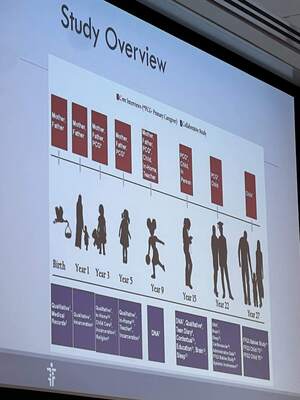
<p>These are just a few of the questions the Future of Families and Child Wellbeing Study <a href="https://ffcws.princeton.edu/">(FFCWS)</a> can help researchers answer. Founded by scholars at Princeton and Columbia Universities, the FFCWS is the longest-running and only contemporary US birth cohort study of young adults, based on a national sample, that follows children from birth through young adulthood. It is used by more than 13,000 researchers, policymakers, and practitioners to understand the effects of poverty, family structure, education, employment, income, health, housing, and resource sharing on human development.</p>
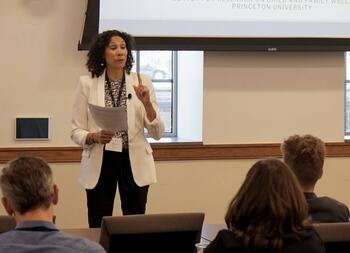
<figure class="image image-right"><img src="https://populationanalytics.nd.edu/assets/659444/350x/anna_1.jpg" alt="A woman, Anna Haskins, in a white blazer speaks, holding papers and gesturing with a raised index finger." width="350" height="253">
<figcaption>Anna Haskins, the Andrew V. Tackes Associate Professor of Sociology and co-investigator of Future of Families and Child Wellbeing Study, discusses her vision for FFCWS@ND, an initiative designed to foster interdisciplinary collaboration and leverage data to find real-world solutions for those experiencing poverty.</figcaption>
</figure>
<p>Following her appointment as co-investigator of FFCWS in 2024, <a href="https://sociology.nd.edu/people/anna-haskins/">Anna Haskins</a>, the Andrew V. Tackes Associate Professor of Sociology, set out to expand engagement with the dataset at the University of Notre Dame and throughout the Midwest. In collaboration with Notre Dame Population Analytics (ND Pop) and with support from the Poverty Initiative, Haskins launched <a href="https://populationanalytics.nd.edu/research/ffcws-at-notre-dame/">FFCWS@ND</a> as a regional hub to encourage research using the dataset and collaboration across disciplines.<strong> </strong></p>
<p>“The challenges that poverty presents are many, and it will take a wide range of research approaches to tackle them. In partnership with ND Pop, the Poverty Initiative is delighted to support FFCWS@ND so that the Notre Dame community can utilize what is arguably the best dataset for understanding the intergenerational effects of poverty in America,” said Jim Sullivan, director of the Notre Dame Poverty Initiative and professor of economics.</p>
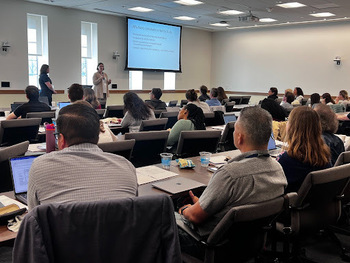
<figure class="image image-left"><img src="https://populationanalytics.nd.edu/assets/659448/350x/ffcws_corner.jpg" alt="A woman speaks to a seated audience in a brightly lit room. A screen behind her reads 'Why Family Complexity is Hard to Study'." width="350" height="263">
<figcaption>Marcy Carlson (R), University of Wisconsin-Madison, and Christine Percheski (L), Northwestern University, present on how they have used the FFCWS dataset to understand family formation and structure.</figcaption>
</figure>
<p>The inaugural <a href="https://populationanalytics.nd.edu/research/ffcws-at-notre-dame/ffcws-nd-data-conference-spring-2026/">FFCWS Data Conference</a>, hosted on April 23-24, was the first phase of a multi-year plan to advance poverty-related research with the dataset. The event brought together 60 scholars including faculty, postdoctoral researchers, graduate students, and study leadership from universities across the Midwest, including Notre Dame, University of Wisconsin-Madison, University of Chicago, Purdue University, University of Michigan, Northwestern University, Michigan State University, and the University of Illinois.</p>
<p>“The Future of Families study is housed on the East Coast, and it is widely used among scholars there. My vision is to build usage across the country, starting with Notre Dame and regionally in the Midwest, by facilitating learning about the data and providing opportunities for interdisciplinary collaboration among regional researchers,” Haskins said. “The broader aim is to build capacity to leverage the data to ask and answer critical poverty-related questions to drive policy change, and to really generate real-world solutions and advanced knowledge.”</p>
<p>To turn that vision into reality, the conference featured a comprehensive introduction to the data, along with presentations from FFCWS principal investigators Kathy Edin (Princeton University) and Jane Waldfogel (Columbia University), who shared the history and current data collection efforts for year 27 of the study. FFCWS data analysts provided an overview of the data available and how to access it, and regional researchers who have worked extensively with the data helped attendees envision how it could be used in their own research.</p>
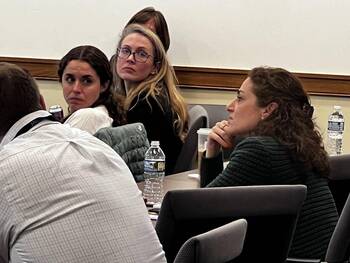
<figure class="image image-right"><img src="https://populationanalytics.nd.edu/assets/659451/350x/ffcws_kearney.jpg" alt="Three women at a meeting. Dark-haired woman looks back concerned. Blonde woman with glasses looks serious. Woman in green sweater looks thoughtful." width="350" height="263">
<figcaption>Melissa Kearney, the Gilbert F. Schaefer Professor of Economics and director of the Strengthening Families Research Initiative, engages with fellow researchers during the FFCWS data conference. As a leading voice on family economics, Kearney’s insights help translate longitudinal data into actionable policy discussions.</figcaption>
</figure>
<p>Lonnie Berger (University of Wisconsin-Madison) and Maggie Thomas (University of Chicago) highlighted how scholars have used the study to understand economic, social, and environmental influences on poverty and material hardship, how poverty impacts family functioning and wellbeing, and how it persists across generations. Marcy Carlson (University of Wisconsin-Madison) and Christine Percheski (Northwestern University) focus their research on family formation and structure; looking at parent relationships to each other and potentially to new partners which provides vast insight into children's exposure to resources, stress, and stability.</p>
<p>Notre Dame’s<a href="https://psychology.nd.edu/people/elizabeth-shewark/"> Elizabeth Shewark</a>, the William J. Shaw Center for Children and Families Collegiate Chair, explored how contextual influences like families, schools, and neighborhoods interact with genetic factors to impact youth's social, emotional, and academic competencies. Colter Mitchell (University of Michigan) presented his work identifying childhood biomarkers for medical conditions like cardiovascular disease, cancer, and dementia to increase the potential for early identification.</p>
<p>As the two-day conference concluded, Haskins was already working on other dimensions of her plan for FFCWS@ND.</p>
<figure class="image image-left"><img src="https://populationanalytics.nd.edu/assets/659452/300x/ffcws_slide.jpg" alt="Timeline of a longitudinal study from birth to age 27, detailing interviews with caregivers, children, and data collection." width="300" height="400">
<figcaption>Following 5,000 families for over two decades, the FFCWS offers an unprecedented look at how early life circumstances and policy environments shape the transition into adulthood.</figcaption>
</figure>
<p>“One of the broader goals of Notre Dame is to be a force of good in the world, particularly among the marginalized and those experiencing poverty,” Haskins said. “It’s a natural fit to bring a data set that can really answer those questions to researchers here at Notre Dame and beyond.”</p>
<p>To support this work, FFCWS@ND provides practical resources aimed at lowering barriers to data access and analysis. Future plans include hosting two more data conferences. FFCWS@ND Postdoctoral Fellows will soon be available to assist ND Pop faculty affiliates in accessing data to research critical poverty-related questions. For Notre Dame faculty and students, small research grants of up to $5,000 will be available on a rolling basis to incentivize use of FFCWS data and help cover costs associated with accessing the restricted data.</p>
<p>For more information on FFCWS@ND, visit ND Pop at <a href="http://populationanalytics.nd.edu">populationanalytics.nd.edu</a>.</p>]]>
    </content>
    <author>
      <name>Heather Frey</name>
    </author>
  </entry>
  <entry>
    <id>tag:populationanalytics.nd.edu,2005:News/183160</id>
    <published>2026-04-30T12:00:00-04:00</published>
    <updated>2026-07-16T14:28:47-04:00</updated>
    <link rel="alternate" type="text/html" href="https://populationanalytics.nd.edu/news-and-events/news/long-term-study-of-covid-lockdown-and-family-life-shows-unexpected-lasting-effects-on-fatherhood/"/>
    <title>Long-term study of COVID lockdown and family life shows unexpected, lasting effects on fatherhood</title>
    <summary type="text">
      <![CDATA[In the years following the COVID-19 pandemic, an ideal vision of family life would have shown that parents are continuing to share in caregiving responsibilities and spending quality time with their children — dads, in particular. Many people hoped that the behavioral changes caused by lockdowns would persist, allowing dads more time and flexibility in the long term and ultimately reshaping how we view fatherhood in general. However, according to new research from Notre Dame anthropologist and fatherhood expert Lee Gettler, those fathering benefits have not outlasted the pandemic itself.]]>
    </summary>
    <content type="html">
      <![CDATA[<p>In the years following the COVID-19 pandemic, much has been said about how the lockdowns created conditions for dual-parent families to spend more time at home with their children. In an ideal vision of family life, this would have led to parents sharing in quality time and caregiving responsibilities, and bonding with their children in a way they hadn’t been able to do before.</p>
<p>In the United States, <a href="https://www.nytimes.com/2025/04/30/opinion/father-child-care-pandemic.html">ample attention was given</a> to the novelty of how dads, in particular, were getting much more time to participate in the daily, often mundane and yet intimate tasks of child-rearing. <a href="https://www.nytimes.com/2020/06/21/opinion/pandemic-fatherhood-fathers.html">Many people hoped</a> that the change would persist, allowing dads more time and flexibility in the long term — ultimately reshaping how we view fatherhood in general.</p>
<p>However, <a href="https://journals.plos.org/plosone/article?id=10.1371/journal.pone.0343636">according to new research</a> from anthropologist and fatherhood expert <a href="https://news.nd.edu/our-experts/lee-gettler/">Lee Gettler</a> of the University of Notre Dame, those fathering benefits have not outlasted the pandemic itself.</p>
<p>“COVID didn’t really lead to a large-scale uptick in this new vision for fathering on the part of dads across the board,” said <a href="https://anthropology.nd.edu/people/lee-gettler/">Gettler</a>, the Rev. John A. O’Brien College Professor of Anthropology and chair of the <a href="https://anthropology.nd.edu/">Department of Anthropology</a>, as well as an affiliated faculty at the <a href="https://globalhealth.nd.edu/">Eck Institute for Global Health</a> and the <a href="https://shaw.nd.edu/">William J. Shaw Center for Children and Families</a>.</p>
<figure class="image image-left"><img src="https://news.nd.edu/assets/566191/lee_gettler_mc_350x350.jpg" alt="Professor Gettler is standing in front of a bookcase and has a blue/grey shirt on with large square design." width="350" height="350">
<figcaption>Lee Gettler is the Rev. John A. O’Brien College Professor of Anthropology and chair of the Department of Anthropology, as well as an affiliated faculty at the Eck Institute for Global Health and the William J. Shaw Center for Children and Families. (Photo by Matt Cashore/University of Notre Dame)</figcaption>
</figure>
<p>“I think what’s been missing from many of those initial reports was a wider perspective on what the realities are for families and fathers in the United States and around the world following the pandemic,” he said, “especially as we think about common jobs for men, precarity in the workplace and economic inequality.”</p>
<p>To address those gaps in understanding, Gettler and his team, which included co-author and postdoctoral research associate <a href="https://anthropology.nd.edu/people/sarah-dennis/">Sarah Hoegler Dennis</a>, relied on 15 years of longitudinal data to compare fathers’ pre-COVID to post-COVID behaviors. The researchers looked at this data from a non-Euro-American perspective in a major metropolitan area in the Philippines.</p>
<p>What they found was that fathering behaviors, for the most part, did not change much before COVID began versus shortly after the pandemic ended.</p>
<p>“There was this idea out there that a meaningful percentage of dads were spending more time with their kids during the lockdown periods, even if they were still working, and that the dynamics of COVID would lead to this long-term effect on what and how much dads were doing within their families,” Gettler said. “And we just didn’t see that prevailing change.”</p>
<p>The research team drew on a large sample of men who were around 25 years old at the start of the study and followed them for the next 15 years as part of a larger set of research in Cebu, Philippines. Gettler and his team have been studying <a href="https://www.sciencedirect.com/science/article/pii/S1090513821000465">fathering</a> and the “<a href="https://www.pnas.org/doi/10.1073/pnas.1105403108">biology of fatherhood</a>” as part of this project for close to 20 years, and have found that fathers in Cebu have become <a href="https://onlinelibrary.wiley.com/doi/full/10.1111/jomf.12568">much more involved in the past few decades</a>, mirroring father involvement in the United States.</p>
<p>During the pandemic, the Philippines also had one of the longest lockdown periods in the world, according to Gettler, with some of the most strict, government-mandated quarantine guidelines in place, making this an appropriate site to test for the effects of the stay-at-home orders on fathering.</p>
<blockquote>
<p>“There are questions remaining about how we can continue to encourage dads in dual-parent families to pull their weight, be a supportive partner or to balance the responsibilities of what it takes to run a household and take care of young children. COVID exposed or habituated more dads to what that can look like, but now we need to enable them to continue that behavior.”</p>
</blockquote>
<p>The researchers used waves of socio-demographic and fathers’ caregiving data collected prior to the pandemic (2009 and 2014) and after the pandemic (2022-23). The main analyses focused on caregiving changes over time for fathers who had young children at home both pre- and post-pandemic, looking at how involved they were with routine, hands-on care for babies and young children, recreational play and activities, and educational caregiving tasks.</p>
<p>“What we found is that COVID — and the time dads spent at home with their children during that period — did not change fathering in any lasting way,” Gettler said. “As soon as life gets back to normal, we see that dads are continuing to do the same thing they were doing before COVID.”</p>
<figure class="image image-right"><img src="https://news.nd.edu/assets/658186/300x/tatay_14_croppedjpg.jpg" alt="Smiling man in glasses holds two joyful young boys in red shirts up on his shoulders, one in white shorts and one in tan." width="300" height="428"></figure>
<p>With one exception, Gettler noted.</p>
<p>For the group of fathers who found themselves going from employed to either unemployed or underemployed because of the pandemic, their involvement with their children’s educational care shot up noticeably, and the change persisted.</p>
<p>“We see this link with employment status and fathers’ ability to spend more time helping kids with school work and homework,” Gettler said. “But that’s the only hint that the conditions surrounding COVID may have contributed to some sort of change in what dads are doing at home.”</p>
<p>At the end of the day, dad’s employment status is the primary predictor for how much care he is providing, Gettler said. He believes that policy changes within the workplace — such as paid paternity leave and widespread flexibility on working from home or setting working hours — might lead to a more lasting change in fatherhood behavior. These structural changes could support permanent shifts in expectations and norms for men as caregivers, and open up more opportunities for dads to get — and stay — involved.</p>
<p>Gettler argued that society needs to recognize how it can better support dads and give them the chance to be more available at home, without the caveat of having to become unemployed or underemployed in order to enjoy such chances to be with their families.</p>
<p>“There are questions remaining about how we can continue to encourage dads in dual-parent families to pull their weight, be a supportive partner or to balance the responsibilities of what it takes to run a household and take care of young children,” Gettler said. “COVID exposed or habituated more dads to what that can look like, but now we need to enable them to continue that behavior.”</p>
<p>Gettler, who is also director of the <a href="https://anthropology.nd.edu/undergraduate/student-opportunities/research/lab-research/#:~:text=The%20Hormones%2C%20Health%2C%20and%20Human%20Behavior%20Laboratory%20(Prof.%20Lee%20Gettler)">Hormones, Health, and Human Behavior Lab</a>, works with collaborators at multiple global sites and is an<a href="https://www.youtube.com/watch?v=K7MG9-Yc8lY"> expert on fatherhood and healthy families</a>, including the psychobiology of motherhood and fatherhood and parents’ physical and mental health, as well as child growth, development and physiology. Presently, Gettler works on research projects related to these interests in the United States, the Philippines and the Republic of the Congo.</p>
<p><em><strong>Contact: Tracy DeStazio,</strong> associate director of media relations, 574-631-9958 or <a href="mailto:tdestazi@nd.edu">tdestazi@nd.edu</a></em></p>
<p class="attribution">Originally published by <span class="rel-author">Tracy DeStazio</span> at <span class="rel-source"><a href="https://news.nd.edu/news/long-term-study-of-covid-lockdown-and-family-life-shows-unexpected-lasting-effects-on-fatherhood/">news.nd.edu</a></span> on <span class="rel-pubdate">April 30, 2026</span>.</p>]]>
    </content>
    <link rel="enclosure" type="image/jpeg" href="https://populationanalytics.nd.edu/assets/666709/tatay_6_.jpeg" title="Smiling man in glasses holds a happy baby with fingers in mouth, both sitting in a patterned hammock outdoors."/>
    <author>
      <name>Tracy DeStazio</name>
    </author>
  </entry>
  <entry>
    <id>tag:populationanalytics.nd.edu,2005:News/183158</id>
    <published>2026-03-25T12:00:00-04:00</published>
    <updated>2026-07-16T14:26:04-04:00</updated>
    <link rel="alternate" type="text/html" href="https://populationanalytics.nd.edu/news-and-events/news/notre-dame-scholar-joins-supreme-court-brief-defending-birthright-citizenship/"/>
    <title>Notre Dame scholar joins Supreme Court brief defending birthright citizenship</title>
    <summary type="text">
      <![CDATA[Amid the Trump administration’s legal challenge to birthright citizenship, Notre Dame's Amy Hsin is among a group of scholars who have submitted an amicus brief to the Supreme Court, providing social science evidence for the justices to consider as they hear a case this spring.]]>
    </summary>
    <content type="html">
      <![CDATA[<figure class="image image-right"><img src="https://keough.nd.edu/assets/653675/original/scotus_supreme_court_building.webp" alt="White marble facade of the US Supreme Court building, featuring columns, a seated statue, and 'EQUAL JUSTICE UNDER LAW'." width="1200" height="800">
<figcaption>The Supreme Court is scheduled to hear Trump v. Barbara this spring. The case could determine the future of birthright citizenship in the United States.</figcaption>
</figure>
<p>Amid the Trump administration’s legal challenge to birthright citizenship, <a href="https://keough.nd.edu/about/faculty-staff-directory/amy-hsin/">Amy Hsin</a> is among a group of scholars who have submitted an amicus brief to the Supreme Court, providing social science evidence for the justices to consider as they hear a case this spring.</p>
<p>The <a href="https://www.supremecourt.gov/DocketPDF/25/25-365/399459/20260226190357248_No.%2025-365_Amicus%20Brief.pdf">brief</a> argues that birthright citizenship — the legal right to citizenship for all children born in the United States — strengthens the country’s economy and promotes better educational and health outcomes. It also warns that ending birthright citizenship would have far-reaching consequences, including expanding the country’s undocumented population.</p>
<p>“The research overwhelmingly shows that birthright citizenship has profoundly positive effects on individuals and society,” said Hsin, professor of migration in the University of Notre Dame’s <a href="https://keough.nd.edu/">Keough School of Global Affairs</a> and a core faculty affiliate of the school’s <a href="https://klau.nd.edu/">Klau Institute for Civil and Human Rights</a>.</p>
<h2>Background: a legal challenge to birthright citizenship</h2>
<p>Hsin was one of the scholars who contributed to the amicus brief in <a href="https://www.justice.gov/osg/media/1416176/dl?inline">Trump v. Barbara</a>. The case centers on a legal challenge to a <a href="https://www.federalregister.gov/documents/2025/01/29/2025-02007/protecting-the-meaning-and-value-of-american-citizenship">2025 executive order</a> by President Trump that would restrict birthright citizenship.</p>
<p>The order says that U.S. citizenship applies only to children whose parents have permanent legal status, but challengers have cited the 14th Amendment to the U.S. Constitution. It states: “All persons born or naturalized in the United States, and subject to the jurisdiction thereof, are citizens of the United States and of the State wherein they reside.”</p>
<p>In U.S. law, this has long been understood through the principle of “jus soli” (“right of the soil”), which dictates that people are U.S. citizens because they are born here, not because of their parents’ legal status. The Trump administration has argued for a narrower interpretation, saying that the children of parents without legal status are not subject to U.S. jurisdiction.</p>
<h2>Brief outlines consequences of narrowing citizenship rights</h2>
<p>Research cited in the brief highlights the negative consequences the authors say would occur as a result of revoking birthright citizenship, including:</p>
<ul>
<li>
<strong>Harming the economy.</strong> The brief cites research showing that immigration increases economic growth, workforce participation and innovation. It notes that children benefiting from birthright citizenship are projected to contribute about $7.7 trillion to the U.S. economy over the period from 1975 to 2074. It also says second-generation immigrants provide a net lifetime fiscal contribution of about $85,000 per person, meaning they pay more in taxes than they receive in benefits. The research shows that citizenship increases earnings and upward mobility, while a lack of legal status reduces productivity and earnings.</li>
<li>
<strong>Reducing educational opportunity.</strong> The brief highlights evidence that legal status strongly influences early childhood learning, K-12 progress and college access. It says that without legal status, students face barriers such as ineligibility for financial aid, restricted employment opportunities and uncertain futures, all of which reduce their incentives to pursue education.</li>
<li>
<strong>Worsening physical and mental health.</strong> Research cited in the brief shows that citizenship affects access to health care and long-term health outcomes, with undocumented immigrants experiencing measurably worse outcomes than those with documentation. This affects a range of health issues, from hypertension and cancer to anxiety and suicide.</li>
<li>
<strong>Expanding the undocumented population.</strong> The brief says ending birthright citizenship would prevent millions of U.S.-born children from becoming citizens — 4.8 million by 2045 and 12.8 million by 2075. That change could affect approximately 255,000 children per year, or about 1 in 18 U.S. births.</li>
</ul>
<p>“We would, for the first time in U.S. history since slavery, create an underclass of people who have no pathways to formal inclusion into the country in which they are born,” Hsin said. “This would mean the erosion of fundamental rights that have been the foundations of who gets to claim citizenship in the United States.”</p>
<h2>Providing evidence for decision makers</h2>
<p>Hsin is one of the 10 scholars who wrote the amicus brief and one of the approximately 140 scholars who signed it. The brief widely cites immigration research, including research by Hsin and fellow Keough School faculty member <a href="https://keough.nd.edu/about/faculty-staff-directory/francesc-ortega/">Francesc Ortega</a>. It builds upon Hsin’s earlier work to provide evidence that can inform courts as well as lawmakers.</p>
<figure class="image image-right"><img src="https://keough.nd.edu/assets/631646/original/amy_hsin_headshot_keough_school.webp" alt="A woman with shoulder-length dark hair wears a tan blazer over a teal and blue patterned blouse and gold hoop earrings." width="1200" height="800" loading="lazy">
<figcaption>Hsin’s contribution to the amicus brief is the latest example of her work to inform decision makers by sharing relevant research.</figcaption>
</figure>
<p>Hsin previously contributed to a 2019 amicus brief submitted to the Supreme Court in support of Deferred Action for Childhood Arrivals recipients, following the Trump administration’s attempt to rescind the program.</p>
<p>In January, she contributed to a <a href="https://news.nd.edu/news/limiting-public-education-access-would-hurt-us-workforce-and-harm-child-welfare-migration-scholar-warns/">policy report</a> outlining the benefits of the landmark 1982 Plyler v. Doe Supreme Court decision, which has faced growing challenges at the state level in recent years. The report highlighted how reversing the decision would disrupt the U.S. workforce and undermine child welfare.</p>
<p>The new brief continues Hsin’s work to inform decision makers by sharing relevant research.</p>
<p>“I’m happy to be part of this group of scholars who have worked together on this important document,” Hsin said. “We hope it will contribute insight as the justices consider this case.”</p>
<p><em>Originally published by Josh Stowe at <a href="https://keough.nd.edu/news-and-events/news/notre-dame-scholar-joins-supreme-court-brief-defending-birthright-citizenship/">keough.nd.edu</a> on March 24.</em></p>
<p><em><strong>Contact</strong>: Tracy DeStazio, associate director of media relations, 574-631-9958 or <a href="mailto:tdestazi@nd.edu">tdestazi@nd.edu</a>.</em></p>
<p class="attribution">Originally published by <span class="rel-author">Josh Stowe</span> at <span class="rel-source"><a href="https://news.nd.edu/news/notre-dame-scholar-joins-supreme-court-brief-defending-birthright-citizenship/">keough.nd.edu</a></span> on <span class="rel-pubdate">March 24, 2026</span>.</p>]]>
    </content>
    <link rel="enclosure" type="image/jpeg" href="https://populationanalytics.nd.edu/assets/666707/scotus_building.jpg" title="White marble facade of the US Supreme Court building, featuring columns, a seated statue, and 'EQUAL JUSTICE UNDER LAW'."/>
    <author>
      <name>Josh Stowe</name>
    </author>
  </entry>
  <entry>
    <id>tag:populationanalytics.nd.edu,2005:News/179188</id>
    <published>2026-02-13T13:14:00-05:00</published>
    <updated>2026-02-13T13:14:06-05:00</updated>
    <link rel="alternate" type="text/html" href="https://populationanalytics.nd.edu/news-and-events/news/therapy-during-detention-found-to-be-an-effective-cost-efficient-way-to-reduce-violent-behavior-within-jail-system/"/>
    <title>Therapy during detention found to be an effective, cost-efficient way to reduce violent behavior within jail system</title>
    <summary type="text">
      <![CDATA[A new study by University of Notre Dame researchers shows that introducing a unique and low-cost cognitive behavioral therapy program for longer-term jail inmates teaches lifelong skills and reduces violent behavior — making the jail system safer in the long run.]]>
    </summary>
    <content type="html">
      <![CDATA[<p>More than 7 million people were incarcerated in the jail system in 2022, with roughly 660,000 detained on any given day, many awaiting trials or prison sentences. Jail stays can be long, up to a year or more, and there has been an increase in the average length of stay over the past 15 years, made worse by case backlogs from the COVID-19 pandemic.</p>
<p>About one quarter of inmates have a serious mental illness, and 63% struggle with drug dependence or abuse, often coinciding with behavioral problems. Those awaiting trial for serious offenses may tend toward violence, making jail time dangerous for both inmates and jail employees. In addition, the county jail system, which is often viewed as a short-term, transitional time period for inmates, is typically overlooked for providing meaningful therapy opportunities and other interventions.</p>
<p>A new study by University of Notre Dame researchers shows that introducing a unique and low-cost cognitive behavioral therapy (CBT) program for longer-term jail inmates teaches lifelong skills and reduces violent behavior — making the jail safer in the long run.</p>
<p>“Despite the fact that most people are in jail for a short time, many spend months serving a sentence or even years awaiting trial,” said <a href="https://economics.nd.edu/people/mary-kate-batistich/">Mary Kate Batistich</a>, an assistant research professor in the <a href="https://economics.nd.edu/">Department of Economics</a> who works in Notre Dame’s <a href="https://leo.nd.edu/">Wilson Sheehan Lab for Economic Opportunities (LEO)</a>.</p>
<p>“These inmates often come into the jail system with traumatic pasts and with much higher rates of mental illness and substance use disorders than the general population,” she said. “Violence is an issue in jails, as are behavioral problems, with suicide and homicide rates much higher than you’d think, considering that this population is confined and surveilled.”</p>
<p>In their <a href="https://news.nd.edu/assets/648560/step_up_2026_01_24.pdf">working paper</a>, Batistich’s research team reported that inmates who participate in CBT programs experience a 49% drop in behavioral incidents and a 50% drop in physical assaults on other inmates or officers.</p>
<figure class="image image-left"><img src="https://news.nd.edu/assets/648550/400x/mary_kate_batistich_peter_r_1200.jpg" alt="A smiling woman with shoulder-length brown hair and pearl earrings wears a black and brown animal print top." width="400" height="320">
<figcaption>Mary Kate Batistich is an assistant research professor in the Department of Economics and works in Notre Dame’s Wilson Sheehan Lab for Economic Opportunities (LEO). (Photo by Peter Ringenberg/University of Notre Dame)</figcaption>
</figure>
<p>Batistich, along with co-authors <a href="https://economics.nd.edu/people/william-evans/">William Evans</a>, the Keough-Hesburgh Professor of Economics at Notre Dame and co-founder of LEO; Tyler Giles of Wellesley College; and Rebecca Margolit-Chan of Cornell University, examined <a href="https://leo.us11.list-manage.com/track/click?u=967eba886b4f2e8e50aba7e0c&amp;id=c7f61e0eea&amp;e=08d29d6e91">Step Up</a>, a CBT program administered to inmates at the Lubbock County Detention Center in Lubbock, Texas. Designed for individuals with violent backgrounds or tendencies, the program uses a combination of group classes, one-on-one counseling and a structured workbook to help participants recognize and manage emotions.</p>
<p>Through a self-paced 14- to 21-week curriculum, participants learn how to identify their emotions and the physical sensations that accompany them. The goal is for the inmates to learn to recognize their emotions and change their way of thinking — from making negative behavioral choices to adopting rational and constructive behaviors — as a way to peacefully resolve conflict.</p>
<p>“The underlying philosophy of the program is that although individuals experience negative events (such as an unpleasant confrontation with another person), it is one’s interpretation of the event, rather than the event itself, that leads to negative reactions such as anger and violence,” the researchers wrote.</p>
<p>Typically within a jail system, authorities will respond to more serious behavioral infractions by placing the inmate in solitary confinement, where it is estimated that about 4.4% of the incarcerated population is held at any point in time, according to the study.</p>
<p>“There's been research suggesting that solitary confinement can actually be very harmful to the individual, both psychologically and physically,” Batistich said. “This form of discipline may not even be making the institutions any safer. What we're doing in this paper is offering an alternative by promoting therapy over punitive measures.”</p>
<p>And this alternative is not only replicable on a national scale, but cost effective as well, according to the researchers.</p>
<blockquote>
<p>“There is a real intersection between the criminal justice system and poverty, homelessness, mental illness and substance use disorders. Incarcerated individuals are often dealing with several of these issues and also tend to be overlooked and underserved. These are the people in most need of our care and attention.”</p>
</blockquote>
<p>The cost of implementing the Step Up program — including supplies, curriculum books and personnel — is an average of $618 per participant. Leveraging existing jail space and staff capacity, along with instruction by graduate students at nearby Texas Tech University, have made it possible to keep costs down.</p>
<p>The researchers concluded that therapy designed to reduce violent behavior in jails works well when implemented during incarceration, while participants are kept to a consistent and intensive treatment regimen as they await trial or extended incarceration. Such treatment can “improve one’s behavior in the near term, increase safety within institutions and potentially benefit public safety as well,” they wrote.</p>
<p>“There is a real intersection between the criminal justice system and poverty, homelessness, mental illness, and substance use disorders,” Batistich added. “Incarcerated individuals are often dealing with several of these issues and also tend to be overlooked and underserved. These are the people in most need of our care and attention.”</p>
<p><em><strong id="docs-internal-guid-0ab6becf-7fff-67e6-593d-e0b4d7a86654">Contact: Tracy DeStazio, </strong>associate director of media relations, 574-631-9958 or <a href="mailto:tdestazi@nd.edu">tdestazi@nd.edu</a></em></p>
<p class="attribution">Originally published by <span class="rel-author">Tracy DeStazio</span> at <span class="rel-source"><a href="https://news.nd.edu/news/therapy-during-detention-found-to-be-an-effective-cost-efficient-way-to-reduce-violent-behavior-within-jail-system/">news.nd.edu</a></span> on <span class="rel-pubdate">February 12, 2026</span>.</p>]]>
    </content>
    <link rel="enclosure" type="image/jpeg" href="https://populationanalytics.nd.edu/assets/648788/mlc_21026_county_jail_02_1200.jpg" title="Razor and barbed wire atop a fence near the Saint Joseph County Jail in South Bend, with American flag flying in the background."/>
    <author>
      <name>Tracy DeStazio</name>
    </author>
  </entry>
  <entry>
    <id>tag:populationanalytics.nd.edu,2005:News/183159</id>
    <published>2026-01-26T12:00:00-05:00</published>
    <updated>2026-07-16T14:27:35-04:00</updated>
    <link rel="alternate" type="text/html" href="https://populationanalytics.nd.edu/news-and-events/news/backed-by-notre-dame-research-catholic-charities-fort-worth-and-goodwill-michiana-partner-to-expand-poverty-ending-model/"/>
    <title>Backed by Notre Dame research, Catholic Charities Fort Worth and Goodwill Michiana partner to expand poverty-ending model</title>
    <summary type="text">
      <![CDATA[The University of Notre Dame’s Wilson Sheehan Lab for Economic Opportunities (LEO) is working with Catholic Charities Fort Worth (CCFW) and Goodwill Industries of Michiana to replicate CCFW’s Padua program in the Michiana region — marking the first-ever Padua mission site in the nation.]]>
    </summary>
    <content type="html">
      <![CDATA[<figure class="image image-right"><img src="https://news.nd.edu/assets/646009/padua_mission_leo_1200x800_1_26_26.jpg" alt="A young girl in a yellow shirt with a ponytail rides on an adult's shoulders, arms outstretched like wings, facing a vibrant orange and blue sunset sky." width="600" height="390"></figure>
<p>The University of Notre Dame’s <a href="https://leo.nd.edu/">Wilson Sheehan Lab for Economic Opportunities</a> (LEO) is working with Catholic Charities Fort Worth (CCFW) and Goodwill Industries of Michiana to replicate CCFW’s Padua program in the Michiana region — marking the first-ever Padua mission site in the nation.</p>
<p>Goodwill Michiana’s launch is a major step in a broader effort to expand evidence-based poverty-reduction models to more communities. Through its partnership with Franchise for Good, LEO is applying franchising principles to help evidence-backed programs like Padua expand while protecting what makes them work.</p>
<p>Created by CCFW and named after St. Anthony of Padua — the patron saint of the poor — Padua aims to move clients permanently out of poverty by providing them with intensive, wrap-around case management services. The Padua program uses a client-led, long-term and research-driven approach to redefine traditional case management.</p>
<p>The program was rigorously evaluated by LEO to test the impact of Padua on labor market and other outcomes. Using a randomized controlled trial, <a href="https://leo.nd.edu/news/lessons-learned-paduatm/">LEO researchers studied</a> a group of more than 400 program participants, only 40 percent of whom were employed upon enrollment and whose income placed them at about two-thirds of the federal poverty line.</p>
<p>LEO researchers found that through the Padua program, participants were 25 percent more likely to achieve full-time employment — while also reporting significant improvements in overall health and well-being. The intervention was particularly effective for those not employed at enrollment. For this group, the intervention led to a 67 percent increase in the probability of working full-time and a 46 percent increase in monthly earnings. Those who lacked stable housing before enrollment were 64 percent more likely to secure stable housing.</p>
<p>In the years since the study, LEO has worked alongside Catholic Charities Fort Worth to translate those findings into a model that can be replicated with integrity. That work focuses on identifying the program’s core components and supporting partners to implement them with fidelity as Padua expands to new communities.</p>
<figure class="image image-left"><img src="https://news.nd.edu/assets/551840/300x/jim_sullivan_350x300.jpg" alt="Middle-aged man with gray hair and a light blue shirt smiles at the camera. He sits in an office with two monitors displaying charts and an open textbook on his desk." width="300" height="257">
<figcaption>Jim Sullivan, co-founder and director of the University of Notre Dame’s Wilson Sheehan Lab for Economic Opportunities (LEO). (Photo by Matt Cashore/University of Notre Dame)</figcaption>
</figure>
<p>"Padua shows what’s possible when evidence, dignity and partnership come together,” said <a href="https://leo.nd.edu/people/james-sullivan/">Jim Sullivan</a>, LEO co-founder and director. “We have evidence this program works, and replicating it through trusted partners like Goodwill Michiana is how that evidence can improve lives far beyond where it began.”</p>
<p>Bringing Padua to Michigan and Indiana represents a significant expansion of Padua’s research-backed, holistic approach to ending poverty, extending its reach beyond North Texas to empower more families on their path to lasting stability. The launch of the Padua mission site in Michiana underscores a shared commitment to advance proven, compassionate solutions that empower individuals and families to achieve more for their futures.</p>
<p>“Padua was built with a vision to meet people where they are — a client-led program that honors human dignity, builds emotional resilience and delivers real results,” said Brendan Perry, director of Padua National at <a href="https://catholiccharitiesfortworth.org/">Catholic Charities Fort Worth</a>. “Taking this research-backed model beyond Fort Worth for the first time marks a major step in our mission.”</p>
<p><a href="https://goodwill-ni.org/">Goodwill Industries of Michiana</a>, a respected leader in workforce development and community services, will be the first organization in the nation to replicate the Padua model — bringing its people-first approach and strong community infrastructure to families across the region.</p>
<p>“We are excited to launch the nation’s first Padua mission site right here in our region,” said Debie Coble, president and CEO of Goodwill Industries of Michiana. “This partnership empowers families with personalized support so they can build lasting stability and independence, and truly achieve their most abundant lives.”</p>
<p>Padua pairs each client with a dedicated two-person navigator team who provides personalized, judgment-free support in areas such as housing, employment, education and health. Unlike traditional programs, Padua has no time limits — navigators walk alongside clients for as long as it takes to reach stability and independence.</p>
<p>With a case management staff that works to meet every individual where they are, clients are equipped to tackle both personal and financial challenges, learning how to manage resources, set boundaries and maintain accountability. They are empowered to use the skills and tools they learn to change their trajectories and make their way to a better future.</p>
<p><em><strong id="docs-internal-guid-8c112546-7fff-a2b2-70e5-0a01c210e295">Contact: Tracy DeStazio, </strong>associate director of media relations, 574-631-9958 or <a href="mailto:tdestazi@nd.edu">tdestazi@nd.edu</a> </em></p>
<p class="attribution">Originally published by <span class="rel-author">Kathryn Desai and Tracy DeStazio</span> at <span class="rel-source"><a href="https://news.nd.edu/news/backed-by-notre-dame-research-catholic-charities-fort-worth-and-goodwill-michiana-partner-to-expand-poverty-ending-model/">news.nd.edu</a></span> on <span class="rel-pubdate">January 26, 2026</span>.</p>]]>
    </content>
    <link rel="enclosure" type="image/jpeg" href="https://populationanalytics.nd.edu/assets/666708/padua_mission_leo_1200x800_1_26_26.jpg" title="A young girl in a yellow shirt with a ponytail rides on an adult's shoulders, arms outstretched like wings, facing a vibrant orange and blue sunset sky."/>
    <author>
      <name>Kathryn Desai and Tracy DeStazio</name>
    </author>
  </entry>
  <entry>
    <id>tag:populationanalytics.nd.edu,2005:News/183157</id>
    <published>2026-01-20T12:00:00-05:00</published>
    <updated>2026-07-16T14:24:17-04:00</updated>
    <link rel="alternate" type="text/html" href="https://populationanalytics.nd.edu/news-and-events/news/limiting-public-education-access-would-hurt-us-workforce-and-harm-child-welfare-migration-scholar-warns/"/>
    <title>Limiting public education access would hurt US workforce and harm child welfare, migration scholar warns</title>
    <summary type="text">
      <![CDATA[For more than 40 years, a Supreme Court ruling has guaranteed access to public education regardless of immigration status. Notre Dame migration scholar Amy Hsin warns that reversing it would harm the U.S. workforce and child welfare.]]>
    </summary>
    <content type="html">
      <![CDATA[<figure class="image image-right"><img src="https://keough.nd.edu/assets/645045/original/immigrant_children_united_states.webp" alt="Four diverse children sit in a classroom. A boy in a light blue shirt with dark curly hair raises his hand, looking seriously at the viewer. Next to him, a boy in a yellow shirt and another in orange look forward. A bright window is in the background." width="1200" height="801">
<figcaption>Since 1982, all children in the United States have had access to public education regardless of their immigration status. Recently, several states have challenged this policy.</figcaption>
</figure>
<p>For more than 40 years, a <a href="https://supreme.justia.com/cases/federal/us/457/202/">U.S. Supreme Court ruling</a> has ensured that all children can access public education regardless of their immigration status. There are growing efforts to undo this protection, but University of Notre Dame migration scholar <a href="https://keough.nd.edu/about/faculty-staff-directory/amy-hsin/">Amy Hsin</a> warns such a move would disrupt the U.S. workforce and undermine child welfare.</p>
<p>Hsin has contributed to a <a href="https://www.fwd.us/news/the-power-of-plyler/">new report</a> outlining the benefits of the 1982 Plyler v. Doe decision, drawing on her expertise as a sociologist and social demographer who has conducted extensive research on undocumented students. The report was published by <a href="http://fwd.us">FWD.us</a>, a policy organization that specializes in criminal justice and immigration policy solutions.</p>
<p>“Research underscores the social and economic benefits of equal access to education,” said Hsin, professor of migration at Notre Dame’s <a href="https://keough.nd.edu">Keough School of Global Affairs</a> and an affiliate of the school’s <a href="https://klau.nd.edu/" target="_blank" data-saferedirecturl="https://www.google.com/url?q=https://klau.nd.edu/&amp;source=gmail&amp;ust=1769029140214000&amp;usg=AOvVaw3LDyp0rWBBN33xBONUYAim" rel="noopener">Klau Institute for Civil and Human Rights</a>. “There would be profoundly negative effects to individuals and to society as a whole if Plyler were reversed.”</p>
<h2>Education prepares the workforce</h2>
<p>As a contributor to the report, Hsin provided perspective on how education primes new generations of workers to contribute to the workforce. She drew on research she conducted with Sofya Aptekar, a faculty member at City University of New York’s School of Labor and Urban Studies. The scholars are co-authors of an upcoming book that examines how undocumented New Yorkers navigate school, work and identity.</p>
<p>Hsin said this research showed that in addition to teaching specific skills, schools help prepare undocumented children to participate in the workforce by reinforcing a focus on achievement and self-efficacy.</p>
<figure class="image image-right"><img src="https://keough.nd.edu/assets/631646/original/amy_hsin_headshot_keough_school.webp" alt="A woman with shoulder-length dark hair wears a tan blazer over a teal and blue patterned blouse and gold hoop earrings." width="1200" height="800" loading="lazy">
<figcaption>Notre Dame migration scholar Amy Hsin contributed to a new policy report that explains why reversing Plyer v. Doe would hurt the U.S. workforce and child welfare.</figcaption>
</figure>
<p>“In the classroom, we found that children felt they were treated like human beings rather than a legal problem,” Hsin said. “Schools offer a predictable contract: work hard, learn and advance.”</p>
<p>In addition, Hsin said, schools’ focus on achievement helps children form a sense of self-worth and gives them hope for a future in which they can contribute meaningfully.</p>
<p>That reality is reflected in U.S. workforce numbers. The FWD.us report estimates that access to universal education has enabled more than 350,000 people to work in jobs typically requiring some college education and another 1.3 million in occupations requiring a high school diploma.</p>
<p>The report also found that the educational foundation provided by this access has likely contributed to greater job stability, upward mobility and overall workforce diversification, benefiting the broader U.S. labor market. Workers who have benefited from the decision work in industries including education, the medical sector, banking, consulting, real estate and construction.</p>
<h2>The broader benefits of education access</h2>
<p>Hsin’s work helps frame the larger workforce, economic and public health benefits that universal education access provides. The report also found that this access has:</p>
<ul>
<li>Generated more than $633 billion in net state and local fiscal gains after accounting for educational costs.</li>
<li>Increased beneficiaries’ incomes as well as U.S. gross domestic product by $171 billion between 1982 and 2022 with lifetime GDP contributions expected to total $2.71 trillion.</li>
<li>Prevented 730,000 children who are U.S. citizens from falling into poverty.</li>
<li>Improved nationwide public health outcomes, averting at least $28.9 billion in associated health costs by helping to reduce disability, depression, infant mortality and obesity.</li>
</ul>
<h2>Growing opposition to Plyler v. Doe</h2>
<p>Although universal education access has delivered significant benefits, the policy has seen a resurgence of opposition at the federal and state levels in recent years.</p>
<p>In May 2022, Texas Gov. Greg Abbott told a radio talk show host he thought Plyler should be challenged. In June 2024, a U.S. House of Representatives committee held a hearing on the impact of immigration on public schools.</p>
<p>Challenges continued in 2025. Oklahoma and Tennessee tried to pass legislation that would roll back universal access. Louisiana passed legislation requiring state agencies to track data on undocumented individuals receiving state services. Finally, Texas ended in-state college tuition for many undocumented high school graduates in response to a legal challenge from the U.S. Department of Justice.</p>
<p>Advocates of universal education access anticipate more challenges, Hsin said, adding that a state-level challenge could trigger a Supreme Court case that risks reversing the Plyler decision and wiping out the broader gains it made possible.</p>
<h2>The dangers of policy reversal</h2>
<p>Hsin said a policy reversal would hurt workforce training as well as rising generations of potential workers. In addition, she said, reduced school access would force parents to bring children into workplaces that aren’t safe or suitable for them, and child labor exploitation would worsen.</p>
<p>“Society will ultimately bear the cost of raising children without hope, belonging or a sense of possibility,” Hsin said. “Denying access to schools will formalize a pipeline into child labor and deepen vulnerability and exploitation.”</p>
<p>The report was co-authored by Scott D. Levy, chief policy counsel at FWD.us, and Phillip Connor, a research fellow at Princeton University’s Center for Migration and Development. In addition to Hsin, contributors include Matthew Hall, professor and director of the Cornell Population Center at Cornell University; Joshua Miraglia, a Ph.D. candidate in economics at City University of New York Graduate Center; Francesc Ortega, formerly professor of economics at City University of New York, who joined the Keough School as a faculty member in January;  and Heeju Sohn, associate professor of sociology at Emory University.</p>
<p class="attribution">Originally published by <span class="rel-author">Josh Stowe</span> at <span class="rel-source"><a href="https://keough.nd.edu/news-and-events/news/limiting-public-education-access-would-hurt-us-workforce-and-harm-child-welfare-migration-scholar-warns/">keough.nd.edu</a></span> on <span class="rel-pubdate">Jan. 20</span>.</p>
<p class="attribution"><strong id="docs-internal-guid-5c0c8be7-7fff-15f5-a654-4b6dfb708321">Contact: Tracy DeStazio</strong>, associate director of media relations, 574-631-9958 or <a href="mailto:tdestazi@nd.edu">tdestazi@nd.edu</a></p>]]>
    </content>
    <link rel="enclosure" type="image/jpeg" href="https://populationanalytics.nd.edu/assets/666706/immigrant_children_united_states.jpg" title="Four children sit in a classroom. A boy in a light blue shirt with dark curly hair raises his hand, looking seriously at the viewer. Next to him, a boy in a yellow shirt and another in orange look forward. A bright window is in the background."/>
    <author>
      <name>Josh Stowe</name>
    </author>
  </entry>
  <entry>
    <id>tag:populationanalytics.nd.edu,2005:News/176560</id>
    <published>2025-11-14T15:20:00-05:00</published>
    <updated>2025-11-14T15:20:06-05:00</updated>
    <link rel="alternate" type="text/html" href="https://populationanalytics.nd.edu/news-and-events/news/a-powerful-new-lens-on-poverty-notre-dame-expands-access-to-landmark-family-study/"/>
    <title>A powerful new lens on poverty: Notre Dame expands access to landmark family study</title>
    <summary type="text">
      <![CDATA[How…]]>
    </summary>
    <content type="html">
      <![CDATA[<figure class="image image-right"><img src="https://strategicframework.nd.edu/assets/638348/300x/anna_haskins.jpg" alt="Anna Haskins, presenting as a woman with dark curly hair smiles, wearing a white top and a prominent amber-orange layered beaded necklace." width="225" height="300"></figure>
<p>How do family dynamics, schools, and the justice system shape inequality across generations and communities?</p>
<p>These are the kind of questions that drive <a href="https://sociology.nd.edu/people/anna-haskins/">Anna Haskins’s</a> research. Haskins, the Andrew V. Tackes Associate Professor of Sociology, explores how the education system, the family, and the criminal legal system interact in ways that both preserve and mitigate social inequality.</p>
<p>A new data hub will supercharge research into these questions and more, giving scholars at Notre Dame the tools to study poverty, inequality, and contemporary social life from multiple angles. Joining Princeton and Columbia universities, Notre Dame is poised to host a Midwestern hub of The Future of Families and Child Wellbeing Study (<a href="https://ffcws.princeton.edu/">FFCWS</a>).</p>
<p>The FFCWS is the longest-running and only contemporary US birth cohort study of young adults, based on a national sample, that follows children from birth through young adulthood. It has become a crucial component of the country’s research infrastructure, enabling researchers, policymakers, and practitioners to understand the effects of poverty, family structure, education, employment, income, health, housing, and resource sharing on human development. For the past 25 years, the FFCWS has served as a vital public resource, with more than 8,700 researchers across disciplines using its data to generate insights that inform research agendas, public policy, and social programs.</p>
<p>“Our aim is to build capacity to leverage these unique data to ask and answer the critical poverty-related questions that drive policy change, generate real-world solutions, and advance knowledge — all of which will cement Notre Dame's leadership in poverty research,” Haskins said.</p>
<p>Since its founding by scholars at Princeton and Columbia, the FFCWS has been led exclusively by researchers at these two Ivy League institutions. This changed in 2024 when Haskins was named as a new co-Investigator. Haskins has spent nearly two decades utilizing FFCWS data to examine how the education system, family, and criminal legal system connect and interact in ways that both preserve and mitigate social inequality. This appointment presents a timely opportunity to develop a Midwestern research hub focused on the utilization of FFCWS data.</p>
<figure class="image image-left"><img src="https://strategicframework.nd.edu/assets/638349/logo_with_notre_dame_90925_1_.webp" alt='Blue-teal icon of abstract figures representing a family, next to "Future of Families &amp; Child Wellbeing Study" in gray text. Below, "PRINCETON | COLUMBIA | NOTRE DAME"' width="600" height="200"></figure>
<p>In collaboration with<a href="https://populationanalytics.nd.edu/"> Notre Dame Population Analytics</a>, Haskins will grow FFCWS research at the University through two primary mechanisms. First, by recruiting and hiring postdoctoral fellows with experience working with this data set who can support the research efforts of Notre Dame faculty across various units. Second, by offering data workshops to train faculty, postdoctoral researchers, predoctoral researchers, and students, including hands-on instruction and project ideation with senior researchers. The first of these workshops, to be held on campus in the spring of 2026, will primarily target Notre Dame attendees, but future events will expand to include peer institutions in the region.</p>
<p>Notre Dame Population Analytics harnesses the power of people, computing, and data to equip Notre Dame researchers who are exploring some of the most pressing demographic questions in order to inform policy solutions that shape lives and communities. Notre Dame Population Analytics addresses a variety of topics and questions, including but not limited to mental health access, challenges relating to the aging population and workforce needs, and the opioid crisis.</p>
<p>This work is supported by Notre Dame’s <a href="https://strategicframework.nd.edu/initiatives/poverty-initiative/">Poverty Initiative</a>, a University-wide effort to create a world intolerant of poverty by expanding knowledge about how to solve it.</p>
<p>“I’m very excited to spearhead efforts to build FFCWS data use and infrastructure at Notre Dame in partnership with Notre Dame Population Analytics and with the generous support of the Poverty Initiative,” Haskins said.</p>
<p class="attribution">Originally published by <span class="rel-author">Frederick LaBrecque</span> at <span class="rel-source"><a href="https://strategicframework.nd.edu/news/a-powerful-new-lens-on-poverty-notre-dame-expands-access-to-landmark-family-study/">strategicframework.nd.edu</a></span> on <span class="rel-pubdate">November 12, 2025</span>.</p>]]>
    </content>
    <author>
      <name>Frederick LaBrecque</name>
    </author>
  </entry>
  <entry>
    <id>tag:populationanalytics.nd.edu,2005:News/175033</id>
    <published>2025-09-17T10:42:00-04:00</published>
    <updated>2025-09-17T10:42:14-04:00</updated>
    <link rel="alternate" type="text/html" href="https://populationanalytics.nd.edu/news-and-events/news/professor-of-economics-and-global-affairs-lakshmi-iyer-recognized-as-member-of-all-faculty-team/"/>
    <title>BIG Lab Director Lakshmi Iyer recognized as member of All-Faculty Team</title>
    <summary type="text">
      <![CDATA[At every Notre Dame home football game, the Office of the Provost honors a distinguished member of the faculty as part of the All-Faculty Team. As the Fighting Irish played Texas A&amp;M…]]>
    </summary>
    <content type="html">
      <![CDATA[<p>At every Notre Dame home football game, the <a href="https://provost.nd.edu/">Office of the Provost </a>honors a distinguished member of the faculty as part of the <a href="https://provost.nd.edu/faculty-recognitions/all-faculty-team/">All-Faculty Team.</a> As the Fighting Irish played Texas A&amp;M University on Saturday, Sept. 13, Lakshmi Iyer was recognized.</p>
<div>
<p>Trained as an economist, Iyer’s research explores the intersection of history, politics, and economics, with a strong focus on Asia. Her recent projects have explored whether post-colonial policies can change the long-run effects of historical institutions, when decentralization can improve education and health outcomes, and whether providing formal land rights can improve women’s economic participation. Her new lines of research examine the interplay between governance, global health, and natural resource management.</p>
<p>At Notre Dame, Lakshmi is the academic director of the <a href="https://biglab.nd.edu/">Building Inclusive Growth (BIG) Lab</a>, which develops innovative, long-lasting solutions to help vulnerable populations in developing countries. Iyer’s work aligns with Notre Dame’s <a href="https://strategicframework.nd.edu/initiatives/poverty-initiative/">Poverty Initiative</a>, a University-wide effort to create a world intolerant of poverty by expanding knowledge about how to solve it.</p>
<p>“Growing up in India during a period of economic liberalization, I saw how government policies can shape the economic and human development trajectory of a country," she said. "I was inspired to investigate why and how countries can make progress against poverty, and to identify historical, political, or social barriers to such progress. More than 800 million people still live in extreme poverty around the world. Poverty is not just an economic issue; it is a moral, political and social issue. I am privileged to be working with scholars across several disciplines at Notre Dame and beyond, to investigate how a diverse range of factors contribute to poverty, including history, political institutions, and the inclusion of women.”</p>
<p><a href="https://economics.nd.edu/people/lakshmi-iyer/" class="btn btn-cta">Learn more about Iyer's work</a></p>
</div>
<p class="attribution">Originally published by <span class="rel-author">College of Arts and Letters</span> at <span class="rel-source"><a href="https://al.nd.edu/news/latest-news/professor-of-economics-and-global-affairs-lakshmi-iyer-recognized-as-member-of-all-faculty-team/">al.nd.edu</a></span> on <span class="rel-pubdate">September 16, 2025</span>.</p>]]>
    </content>
    <link rel="enclosure" type="image/jpeg" href="https://populationanalytics.nd.edu/assets/630666/prov_7066_all_facultyfootballplayer_cards_v1_lakshmi_iyer_1200x.jpg" title="Lakshmi Iyer, Professor of Economics and Global Affairs, 2025 Notre Dame All-Faculty Team.  She smiles and wears a gold and blue necklace with a yellow top."/>
    <author>
      <name>College of Arts and Letters</name>
    </author>
  </entry>
  <entry>
    <id>tag:populationanalytics.nd.edu,2005:News/173706</id>
    <published>2025-07-07T13:47:00-04:00</published>
    <updated>2025-07-07T13:47:47-04:00</updated>
    <link rel="alternate" type="text/html" href="https://populationanalytics.nd.edu/news-and-events/news/prioritizing-prenatal-care-may-decrease-low-birth-weight-outcomes-in-the-gambia-notre-dame-research-finds/"/>
    <title>Prioritizing prenatal care may decrease low birth weight outcomes in The Gambia, Notre Dame research finds</title>
    <summary type="text">
      <![CDATA[A new study co-authored by University of Notre Dame researchers highlights the importance of prenatal care for improving the health of mothers and newborns, providing evidence that can inform policy.]]>
    </summary>
    <content type="html">
      <![CDATA[<figure class="image image-right"><img src="https://keough.nd.edu/assets/618426/original/gautam_prenatal_care_study_full_size_76.webp" alt="A healthcare worker in a white coat gives an injection to an infant sitting on their mother's lap, who wears an orange hijab. Other women and children wait in the background." width="1200" height="800">
<figcaption>A new study co-authored by University of Notre Dame researchers provides evidence from The Gambia that can inform policy to prioritize the health of mothers and newborns.</figcaption>
</figure>
<p>In The Gambia, a small country in West Africa, 1 in 10 newborns have a low birth weight — less than 5.5 pounds — and face daunting challenges. They are more likely to die within a month of birth or in their first year, and they experience higher rates of physical and cognitive impairment and higher risks of developing chronic health issues throughout their lives.</p>
<p>But there is a solution: More prenatal checkups support improved birth outcomes. That is a key finding of a new study co-authored by University of Notre Dame researchers, which provides new causal evidence from The Gambia that can help improve the health of newborns. The study was published in <a href="https://doi.org/10.1371/journal.pgph.0003880">PLOS Global Public Health</a>.</p>
<p>“Newborn health, measured by birth weight, is an important marker that not only reflects an infant's immediate well-being but also predicts future health and development,” said co-author <a href="https://keough.nd.edu/about/faculty-staff-directory/santosh-kumar/">Santosh Kumar Gautam</a>, associate professor of development and global health economics and director of doctoral studies in sustainable development for the University of Notre Dame’s <a href="http://keough.nd.edu">Keough School of Global Affairs</a>. “Our study found that more prenatal checkups produce better birth outcomes, and these findings can inform policies that will prioritize the health of mothers and their newborn children.”</p>
<p>Previous studies in other contexts have shown a causal link between prenatal checkups and improved birth outcomes, Gautam said. Within The Gambia, previous studies had shown an association between checkups and outcomes, but there was limited empirical evidence estimating the causal effects these checkups have on low birth weight. However, in this latest study, Notre Dame researchers moved beyond correlation to demonstrate a causal link, Gautam said.</p>
<figure class="image image-right"><img src="https://keough.nd.edu/assets/618427/original/santosh_kumar_gautam87.webp" alt="Santosh Gautam, a man wearing glasses, a light pink shirt, a patterned tie, and a gray vest stands in a hallway." width="1200" height="800" loading="lazy">
<figcaption>Study co-author Santosh Kumar Gautam conducts research exploring the intersection of global health and poverty reduction.</figcaption>
</figure>
<p>The study analyzed data on more than 4,400 births from the 2019-20 Gambian Demographic and Health Survey. Researchers found that each prenatal checkup was associated with a small increase in birth weight — about .77 ounces — and a 1.2 percent reduction in low birth weight, Gautam said.</p>
<p>But Gautam stressed that prenatal checkups had a cumulative effect: Mothers who had four or more prenatal checkups were 3.9 percent less likely to have a newborn with low birth weight than mothers who had fewer than four checkups. The average treatment effect for having four or more checkups was a 2.5-ounce increase in birth weight and a 4.7 percent reduction in the incidence of low birth weight. Gautam said these improvements would help to reduce deaths within the first month and the first year after birth.</p>
<p>Prenatal checkups play a vital role in detecting and managing conditions like intrauterine growth restriction, Gautam said, which occurs when a baby does not grow at the expected rate during pregnancy. The interventions delivered during these visits, including iron and folic acid supplementation and ongoing education about healthy behaviors, can target the causes of low fetal growth and ensure babies have a healthy weight at birth, he said.</p>
<p>Gautam co-authored the study with Alasana Suso, a 2024 graduate of the Keough School's <a href="https://keough.nd.edu/academics/master-of-global-affairs/">Master of Global Affairs</a> program, and <a href="https://research.nd.edu/people/elizabeth-wood/">Elizabeth Wood</a>, associate professor of the practice and director of the <a href="https://globalhealth.nd.edu/education-training/masters/">Master of Science in Global Health</a> program within the University's <a href="https://globalhealth.nd.edu/">Eck Institute for Global Health</a>.</p>
<figure class="image image-right"><img src="https://keough.nd.edu/assets/619962/original/liz_wood_2025_headshot.webp" alt="Woman with shoulder-length blond hair, wearing a red blazer and patterned top with a turquoise necklace, smiles at the camera against a gray background." width="512" height="341" loading="lazy">
<figcaption>Elizabeth Wood, one of the study’s co-authors, works to build human and institutional capacity within low- and middle-income countries.</figcaption>
</figure>
<p>The research is part of the larger work that the Eck Institute for Global Health does to address the critical healthcare needs of pregnant and postpartum women and their children. Through its <a href="https://globalhealth.nd.edu/impact/">Maternal, Newborn and Child Health Initiative</a>, the institute fosters interdisciplinary collaborations and inspires advancements to improve health outcomes around the world. The research is also part of larger work by the Keough School to address issues relating to global poverty and inequality.</p>
<p>Gautam and Wood said future research should examine the comprehensiveness and quality of prenatal checkups to determine which components most effectively support fetal growth and neonatal survival in resource-constrained settings such as The Gambia.</p>
<p>Ultimately, researchers said, this study and new work that builds on it can provide additional evidence that will inform public health policy and improve birth outcomes.</p>
<p>“Our findings are especially valuable for guiding policy in sub-Saharan Africa, as they highlight both the quantity and quality of care as essential for meaningful gains in neonatal health,” Wood said. “These insights underscore the urgent need for sustained investments to ensure mothers have access to comprehensive prenatal checkups so that their children start life on a healthy path.”</p>
<p class="attribution">Originally published by <span class="rel-author">Josh Stowe</span> at <span class="rel-source"><a href="https://keough.nd.edu/news-and-events/news/prioritizing-prenatal-care-may-decrease-low-birth-weight-outcomes-in-the-gambia-notre-dame-research-finds/">keough.nd.edu</a></span> on <span class="rel-pubdate">June 19</span>.</p>
<p class="attribution"><em><strong>Contact:</strong> <strong>Tracy DeStazio, </strong>associate director of media relations, 574-631-9958 or <a href="mailto:tdestazi@nd.edu" target="_blank" rel="noopener">tdestazi@nd.edu</a></em></p>]]>
    </content>
    <link rel="enclosure" type="image/jpeg" href="https://populationanalytics.nd.edu/assets/621686/gautam_prenatal_care_study_full_size_95.jpg" title="A healthcare worker in a white coat gives an injection to an infant sitting on their mother's lap, who wears an orange hijab. Other women and children wait in the background."/>
    <author>
      <name>Josh Stowe</name>
    </author>
  </entry>
  <entry>
    <id>tag:populationanalytics.nd.edu,2005:News/173349</id>
    <published>2025-06-17T15:45:00-04:00</published>
    <updated>2025-06-17T15:46:04-04:00</updated>
    <link rel="alternate" type="text/html" href="https://populationanalytics.nd.edu/news-and-events/news/video-anthropology-professor-lee-gettler-studies-the-biology-of-fatherhood-and-its-effects-on-children-and-families/"/>
    <title>Video: Anthropology professor Lee Gettler studies the biology of fatherhood and its effects on children and families</title>
    <summary type="text">
      <![CDATA[Lee Gettler is a professor and chair of the Department of…]]>
    </summary>
    <content type="html">
      <![CDATA[<p><iframe width="800" height="449" src="https://www.youtube.com/embed/K7MG9-Yc8lY" allowfullscreen="allowfullscreen"></iframe></p>
<p><a href="https://anthropology.nd.edu/people/faculty/lee-gettler/">Lee Gettler</a> is a professor and chair of the <a href="https://anthropology.nd.edu/">Department of Anthropology</a> at the University of Notre Dame. He is also the director of Notre Dame’s Hormones, Health, and Human Behavior Laboratory, and his research focuses on male hormonal changes during major life transitions like marriage and fatherhood.</p>
<p>To understand how men’s bodies adjust to parenthood, Gettler studies fathers around the world — from South Bend to the Philippines. He hopes his findings can strengthen families by supporting men’s ability to support their children and partners.</p>
<h2 dir="ltr">Video transcription:</h2>
<p>Lee Gettler: I’m Lee Gettler. I’m a professor in the Department of Anthropology.</p>
<p>My research largely focuses on the biology of fatherhood, particularly men’s hormones. So I look at how men’s hormones change across major life transitions, like becoming a new father or getting married. And then I look at how that relates to men’s roles within families and their own health.</p>
<p>There were lots of scientists looking at those types of questions in other species where dads help take care of young, especially in birds. I was able to take that toolkit from anthropology, turn the lens onto humans, and ask questions about how human biology might change in ways that are actually very similar to what you see in other vertebrate species where biparental care or care by both mom and dad has evolved.</p>
<p>Using a long-running study in the Philippines, we were able to look at how men’s hormones changed as they went from being single nonfathers to newly partnered, new dads. We’ve also done research here locally in the community in South Bend, partnering with Beacon Memorial Hospital, in which we looked at dads on the birthing unit, right in the moments when their babies were born. We were looking at how responsive their hormones like testosterone and oxytocin were to the first time they ever interacted with their new babies after they were born.</p>
<p>I also work with two different cultural groups who live really remotely in the rainforest in the Republic of the Congo in Africa. They have very different models of family life in terms of what fathers do, what fathers’ roles are, how fathers support their partners and their kids.</p>
<p>And I think there are really important questions to be asked about how this takes shape in diverse forms around the world. This work is ultimately about trying to understand the way that men’s bodies can adjust and acclimate to the demands of parenthood and how that relates to the roles they play in caring for their children and supporting their partners.</p>
<p>So if we can develop a really good understanding of what types of experiences actually help bring these biological changes online in men, then we can develop better interventions to help support men’s ability to be high-quality caregivers and to be supportive partners.</p>
<p>Ultimately, that’s really critical for strengthening families and helping to facilitate healthy father-child relationships, which we know have really profound positive impacts on children’s long-term development and health.</p>
<p>I think Notre Dame is an ideal place to study these questions about family life and fatherhood. I had support from the college to have a year of sabbatical when I got an external fellowship that really laid the groundwork for some of the significant publications that I’ve been able to put out in the last few years. It’s really the community here but also the tremendous support that we get from the college that facilitates research excellence.</p>
<p class="attribution">Originally published by <span class="rel-author">Jon Hendricks</span> at <span class="rel-source"><a href="https://al.nd.edu/news/latest-news/video-anthropology-professor-lee-gettler-studies-the-biology-of-fatherhood-and-its-effects-on-children-and-families/">al.nd.edu</a></span> on <span class="rel-pubdate">June 11, 2025</span>.</p>]]>
    </content>
    <link rel="enclosure" type="image/jpeg" href="https://populationanalytics.nd.edu/assets/619685/lee_gettler_thumbnail.jpg" title="Two scientists in white lab coats examine data on a computer monitor in a lab.  A man wearing blue gloves points at the screen while a woman looks on."/>
    <author>
      <name>Jon Hendricks</name>
    </author>
  </entry>
  <entry>
    <id>tag:populationanalytics.nd.edu,2005:News/171233</id>
    <published>2025-03-31T15:48:00-04:00</published>
    <updated>2025-03-31T15:48:17-04:00</updated>
    <link rel="alternate" type="text/html" href="https://populationanalytics.nd.edu/news-and-events/news/who-the-messenger-is-matters-cultural-leaders-can-positively-influence-population-growth/"/>
    <title>‘Who the messenger is matters’: Lakshmi Iyer shows that cultural leaders can positively influence population growth</title>
    <summary type="text">
      <![CDATA[Fertility rates across the world have been steadily dropping since 1950. Pinpointing the reasons is at the heart of Lakshmi Iyer's work as a professor of economics and global affairs. Her research exemplifies the kind of population-level research that Notre Dame Population Analytics (ND Pop), a new research initiative at the University, seeks to foster.]]>
    </summary>
    <content type="html">
      <![CDATA[<p>Fertility rates across the world have been steadily dropping since 1950. Pinpointing the reasons — despite the lack of typical causal conditions such as famine or war — is at the heart of one researcher’s work at the University of Notre Dame.</p>
<p><a href="https://keough.nd.edu/about/faculty-staff-directory/lakshmi-iyer/">Lakshmi Iyer</a>, a professor in the <a href="https://economics.nd.edu/">Department of Economics</a>, found that there was more to fertility rates than a simple economic or circumstantial explanation. According to her research, people are having fewer children due to cultural factors, with social norms playing a larger role than previously thought.</p>
<p>Popular opinions regarding marriage, contraception and abortion directly impact fertility rates and therefore the demography of a region. This can be particularly true in regions that are predominantly Catholic and where the Church’s teachings have a stronger influence on an individual’s fertility decisions.</p>
<p>“Social norms truly matter when it comes to understanding demography,” said Iyer, who is also a professor of economics and global affairs at Notre Dame’s <a href="https://keough.nd.edu/">Keough School of Global Affairs</a> and a faculty fellow at the school’s <a href="http://kellogg.nd.edu/">Kellogg Institute for International Studies</a> and <a href="http://asia.nd.edu/">Liu Institute for Asia and Asian Studies</a>. “And we are researching how changing the salience of specific norms is shaping fertility behavior.”</p>
<p>Iyer and her research team examined the impact of visits by Pope John Paul II throughout Latin America between 1979 and 1996. They found that in countries where he gave public speeches that reinforced Catholic social teaching, fertility rates were higher in the long term. Using Demographic and Health Survey (DHS) data on 13 Latin American countries across 16 papal visits, the researchers found that although the pope’s speeches were not intentionally aimed at influencing fertility, his messaging heightened existing Catholic social norms that promote getting married and having families, causing a statistically significant increase in birth rates within those countries.</p>
<p>The findings, which were reported in the working paper <a href="https://populationanalytics.nd.edu/assets/606960/iyer_etal_wp_202501.pdf">“Religion and Demography: Papal Influences on Fertility,”</a> indicated that in the two to five years following the papal visits, an additional 220,000 to 251,000 births occurred in the 13 countries analyzed in the study. Where the pope mentioned marriage or abortion and contraception in his public speech, birth rates jumped the greatest. Where he condemned premarital sex in his homilies, birth rates decreased. Where he spoke about the value of marriage, both marriage and fertility rates increased.</p>
<p>The researchers said the effects of the pope’s messages were felt most strongly by individuals who were not necessarily following the Church’s teachings on these topics; in this case, those in non-Catholic, wealthy and highly educated households.</p>
<p>“These results indicate that people are really listening to what the pope has to say,” Iyer said. “And the topics he addresses really matter.”</p>
<figure class="image image-left"><img src="https://news.nd.edu/assets/610945/lakshmi_iyer.jpg" alt="A woman with dark hair and glasses smiles against a light gray background. She wears a red top with a black and white floral pattern." width="600" height="480">
<figcaption>Lakshmi Iyer, a professor in the Department of Economics at the University of Notre Dame. (Photo by Peter Ringenberg/University of Notre Dame)</figcaption>
</figure>
<p>Iyer added that not only were the messages important in changing how the audiences viewed their relationship with marriage and family, but so was the fact that it was the pope himself delivering those messages.</p>
<p>“Who the messenger is matters,” Iyer said. “It needs to be someone who can reinforce what is important to the culture. You can change social norms by having a predominant leader remind people of what is considered good and acceptable behavior within that particular society.”</p>
<p>For Latin America at the time of Pope John Paul’s visits, these messages were crucial to help slow down the dramatic decline in birth rates, which went from an average of 5.9 births per woman in 1960 to 2.2 in 2010. For other countries experiencing similar below-replacement fertility rates, Iyer said this type of messaging can help induce people to want to have more children.</p>
<p>And those messages don’t have to be tied to a specific religion or to religious beliefs, Iyer added, but they do need to be relevant to the culture they are addressing and to the existing social norms — and having them delivered by a respected leader only adds to their saliency.</p>
<p>“Cultural ambassadors matter, but only in certain contexts,” Iyer explained. “They are the ones who can speak for those norms, reinforce them or make them more important to people.”</p>
<p>This study exemplifies the kind of population-level research that <a href="https://populationanalytics.nd.edu/">Notre Dame Population Analytics (ND Pop)</a>, a <a href="https://news.nd.edu/news/college-of-arts-letters-launches-nd-population-analytics-to-accelerate-policy-relevant-work-through-big-data/">new research initiative</a> at the University, seeks to foster. Many of the issues facing society are demographic — poverty, the aging population and declining fertility, disparities in educational outcomes, family instability and the decline in life expectancy brought about by the drug crises. ND Pop is leveraging the tools of data science to foster impactful research that can inform policy and practice. Iyer’s paper and other recent population study findings are available through ND Pop’s <a href="https://populationanalytics.nd.edu/research/publications/">working paper series</a>.</p>
<blockquote>
<p>“Who the messenger is matters. It needs to be someone who can reinforce what is important to the culture.”</p>
</blockquote>
<p>“Demography is really important to think about in terms of long-term economic or social change,” Iyer said. Aside from policies that promise monetary incentives or better access to child care for families, Iyer and her co-authors believe that a cultural component could also be considered. They acknowledge, however, that further research should be conducted to analyze the effects of other changes in social norms such as increased secularization or changing religious denominations in a country, as well as contrasting these with the effects of government policies and economic incentives.</p>
<p>Iyer conducted her research alongside co-authors Paloma Lopez de mesa Moyano of Emory University and Vivek Moorthy, who received his doctorate from Notre Dame in 2022 and is now at the College of the Holy Cross.</p>
<p>The DHS surveys are nationally representative household surveys conducted in more than 90 countries since the mid-1980s. They collect detailed information from women of child-bearing age about their fertility histories, including a retrospective questionnaire on the month and year of all births. These fertility histories enabled the researchers to construct fertility time series for each woman using a consistent survey methodology and questionnaire across countries.</p>
<p><em><strong>Contact: Tracy DeStazio, </strong>associate director of media relations, 574-631-9958 or <a href="mailto:tdestazi@nd.edu">tdestazi@nd.edu</a></em></p>
<p class="attribution">Originally published by <span class="rel-author">Tracy DeStazio</span> at <span class="rel-source"><a href="https://news.nd.edu/news/who-the-messenger-is-matters-cultural-leaders-can-positively-influence-population-growth/">news.nd.edu</a></span> on <span class="rel-pubdate">March 31, 2025</span>.</p>]]>
    </content>
    <link rel="enclosure" type="image/jpeg" href="https://populationanalytics.nd.edu/assets/611252/nd_pop_graphic_1200x675.jpg" title="A large red magnifying glass lies on a bright blue surface surrounded by numerous tiny figurines of people."/>
    <author>
      <name>Tracy DeStazio</name>
    </author>
  </entry>
  <entry>
    <id>tag:populationanalytics.nd.edu,2005:News/169915</id>
    <published>2024-12-12T14:23:00-05:00</published>
    <updated>2025-02-10T14:24:31-05:00</updated>
    <link rel="alternate" type="text/html" href="https://populationanalytics.nd.edu/news-and-events/news/college-of-arts-letters-launches-nd-population-analytics-to-accelerate-policy-relevant-work-through-big-data/"/>
    <title>College of Arts &amp; Letters launches ND Population Analytics to accelerate policy-relevant work through big data</title>
    <summary type="text">
      <![CDATA[In partnership with the University of Notre Dame’s Poverty Initiative, the College of Arts &amp; Letters has launched a data-focused research effort that will foster and advance multidisciplinary work on a wide range of pressing demographic issues facing society, including poverty, rising inequality, declining health in the United States, family instability and falling religious participation.]]>
    </summary>
    <content type="html">
      <![CDATA[<p>In partnership with the University of Notre Dame’s <a href="https://strategicframework.nd.edu/initiatives/poverty-initiative/">Poverty Initiative</a>, the <a href="https://al.nd.edu/">College of Arts &amp; Letters</a> has launched a data-focused research effort that will foster and advance multidisciplinary work on a wide range of pressing demographic issues facing society, including poverty, rising inequality, declining health in the United States, family instability and falling religious participation.</p>
<p>Notre Dame Population Analytics (ND Pop) will catalyze policy-relevant research by creating an ecosystem of scholars on campus who strive to tackle important population-level issues in their work. Led by <a href="https://economics.nd.edu/people/william-evans/">William Evans</a>, the Keough-Hesburgh Professor of Economics and co-founder of the <a href="https://leo.nd.edu/">Wilson Sheehan Lab for Economic Opportunities,</a> ND Pop will be a hiring and convening force for innovative social scientists, empowering them with access to curated datasets, specialized staff and research associates, and other essential support services.</p>
<figure class="image image-left"><img src="https://news.nd.edu/assets/597521/300x/bill_evans_bj_400x500.jpg" alt="Headshot of Bill Evans with short gray hair and glasses. He wears a light blue button-down shirt and a dark blue and gray striped tie. He is posed against a plain gray background." width="300" height="375">
<figcaption>William Evans (Photo by Barbara Johnston/University of Notre Dame)</figcaption>
</figure>
<p>“Many of the problems facing the U.S. and other nations are demographic issues — the aging of the population, declining fertility, heavy concentration of the opioid crisis in at-risk populations and disparities in education outcomes across groups,” Evans said. “Driven by its Catholic mission, Notre Dame is uniquely positioned to provide a voice on these key issues.”</p>
<p>By leveraging the tools of data science, ND Pop aims to promote human flourishing through producing impactful research that can inform policy and practice.</p>
<p>“One of the most exciting aspects about this work is taking research beyond the academy and making it more actionable,” Evans said. “Accessing big data will help us understand the dynamics of these key issues. We will be able to leverage the growing infrastructure at Notre Dame to create a lasting impact by informing policymakers, educators, health care providers, social service workers and others.”</p>
<p>Through partnerships with <a href="https://research.nd.edu/">Notre Dame Research</a>, the <a href="https://crc.nd.edu/">Center for Research Computing</a> and the <a href="https://lucyinstitute.nd.edu/">Lucy Family Institute for Data &amp; Society</a>, ND Pop will aim to establish a Federal Statistical Research Data Center (RDC), which would bring a secure research environment to campus for social science researchers to responsibly access sensitive data.</p>
<p>ND Pop has also quickly built up staff support for population research, hiring a project manager, a partnership program manager and three predoctoral research associates. ND Pop’s partnership program manager, in partnership with Notre Dame Research, will assist with grant proposals to ensure faculty have the resources to capitalize on prestigious funding opportunities and improve the efficiency of the grant application process.</p>
<figure class="image image-right"><img src="https://news.nd.edu/assets/597520/300x/jeff_rhoads_formal_400x500_use_this_one.jpg" alt="A headshot of Jeff Rhoads wearing a navy blue suit, gold tie, and glasses against a gray backdrop." width="300" height="375">
<figcaption>Jeffrey F. Rhoads (Photo by University of Notre Dame)</figcaption>
</figure>
<p>“Notre Dame has long been a driving force behind some of the most significant research on poverty,” said <a href="https://research.nd.edu/people/jeffrey-rhoads/">Jeffrey F. Rhoads</a>, vice president for research and professor in the <a href="https://ame.nd.edu/">Department of Aerospace and Mechanical Engineering</a>. “Notre Dame Research is proud to partner with ND Pop to further enhance that strength by connecting it with the University’s expanding capabilities in advanced data and computational science.”</p>
<p>ND Pop’s three predocs work with faculty across the sociology, psychology and economics departments to run the day-to-day operation of research projects and handle tasks such as coding, data cleaning and constructing data-sharing agreements. The predocs currently provide support for research that examines socioemotional outcomes for families who have experienced intimate partner violence, data on gender differences in child care, and the Census Tree dataset that uses machine learning models to link historical U.S. Census records.</p>
<p>With initial funding from the Poverty Initiative, ND Pop has begun supporting current faculty research and hiring. ND Pop is partnering with the <a href="https://keough.nd.edu/">Keough School of Global Affairs</a> to support new faculty positions for preeminent scholars working at the intersection of migration and poverty, and it plans to be actively involved in attracting talented faculty in areas of research such as history, health and aging.</p>
<p>“To maximize the potential for ND Pop, we need broader representation of faculty with these skills across the social sciences,” Evans said. “The investments in research infrastructure will not only make current faculty more productive, but they will make Notre Dame an attractive destination for scholars in population analytics.”</p>
<figure class="image image-left"><a href="https://sociology.nd.edu/people/steven-alvarado/"><img src="https://news.nd.edu/assets/597522/300x/steven_alvarado_mc_400x500.jpg" alt="A headshot of Steven Alvarado against a gray backdrop. He smiles warmly at the camera, dressed in a dark suit, white shirt, and patterned blue tie. He has short, dark hair with flecks of gray." width="300" height="375"></a>
<figcaption>Steven Alvarado (Photo by Matt Cashore/University of Notre Dame)</figcaption>
</figure>
<p><a href="https://sociology.nd.edu/people/steven-alvarado/">Steven Alvarado</a>, an associate professor of sociology, is working with a predoctoral research assistant to gather information from the U.S. Bureau of Labor Statistics for a project regarding spatial inequality. His team is also accessing and dissecting data from the Indiana Department of Education for a project that examines the presence of weapons in K-12 schools and its impact on students’ education.</p>
<p>Having access to statistical population data, Alvarado said, is essential for his research on understanding the causes and effects of inequality.</p>
<p>“This is the type of research that Notre Dame can really make its mark on,” Alvarado said. “Through the development and infusion of efforts into expanding a population research science center, it can almost instantaneously elevate the national research profile of not only the social sciences at Notre Dame, but the University as a whole.”<br><br></p>
<p><em><strong id="docs-internal-guid-f99023d0-7fff-c7c0-0a5b-24151447734b">Contact: Tracy DeStazio, </strong>associate director of media relations, 574-631-9958 or <a href="mailto:tdestazi@nd.edu">tdestazi@nd.edu</a></em></p>
<p class="attribution">Originally published by <span class="rel-author">Mary Kinney</span> at <span class="rel-source"><a href="https://news.nd.edu/news/college-of-arts-letters-launches-nd-population-analytics-to-accelerate-policy-relevant-work-through-big-data/">news.nd.edu</a></span> on <span class="rel-pubdate">December 12, 2024</span>.</p>]]>
    </content>
    <link rel="enclosure" type="image/jpeg" href="https://populationanalytics.nd.edu/assets/604741/mc_22424_snow_scenic_1200x675_2_.jpg" title="A picturesque winter view of the Main Building at the University of Notre Dame. The Golden Dome is prominent against a clear blue sky. Snow-dusted trees frame the scene, and a brick pathway leads to the building's entrance. The foreground is covered in a blanket of snow."/>
    <author>
      <name>Mary Kinney</name>
    </author>
  </entry>
  <entry>
    <id>tag:populationanalytics.nd.edu,2005:News/169917</id>
    <published>2024-09-01T14:27:00-04:00</published>
    <updated>2025-02-10T14:29:00-05:00</updated>
    <link rel="alternate" type="text/html" href="https://populationanalytics.nd.edu/news-and-events/news/sociology-professor-anna-haskins-announced-as-a-co-investigator-of-ffcws/"/>
    <title>Sociologist Anna Haskins joins Future of Families and Child Wellbeing Study as co-investigator</title>
    <summary type="text">
      <![CDATA[Anna Haskins, the Andrew V. Tackes Associate Professor of Sociology at the University of Notre Dame, will be a co-investigator at the Future of Families and Child…]]>
    </summary>
    <content type="html">
      <![CDATA[<p><a href="https://sociology.nd.edu/people/anna-haskins/">Anna Haskins</a>, the Andrew V. Tackes Associate Professor of <a href="https://sociology.nd.edu/">Sociology</a> at the University of Notre Dame, will be a co-investigator at the <a href="https://ffcws.princeton.edu/">Future of Families and Child Wellbeing Study (FFCWS)</a>.</p>
<p>A joint effort by Princeton University’s <a href="http://crcw.princeton.edu/">Bendheim-Thoman Center for Research on Child and Family Wellbeing</a> and the <a href="http://cupop.columbia.edu/">Columbia Population Research Center</a>, the FFCWS examines the sociological impacts of unmarried parents and their children by collecting longitudinal data from a stratified, multistage sample of about 5,000 children born in large U.S. from 1998 to 2000. Families were interviewed shortly after the birth of their child and when children were approximately ages 1, 3, 5, 9, 15, and 22. Additional collaborative projects have enriched the core study by adding new questions to the surveys or by collecting new data on a subset of parents and children.</p>
<p>Haskins has been involved with the FFCWS for many years, using its data for nearly two decades and serving on the study’s advisory board. Her research examines how three of America’s most powerful social institutions — the education system, the family, and the criminal legal system — connect and interact in ways that both preserve and mitigate social inequality. Her work has focused on early educational outcomes, intergenerational impacts, and disparities by race/ethnicity. Her papers using the FFCWS data have been published in the American Sociological Review, Social Forces, Sociological Science, Criminology, Sociology of Education and Social Science Research, among other scholarly outlets. She is co-editor of the book – When Parents are Incarcerated: Interdisciplinary Research and Interventions to Support Children (2018, APA Press).</p>
<p>Haskins’ current projects explore processes through which schools inhibit or promote institutional engagement among system-involved families, as well as studying more complicated intersections between schooling and punishment such as college-in-prison programs. She is also a former elementary school teacher, a William T. Grant Foundation and National Science Foundation-funded scholar, and co-editor of the journal Sociology of Education.</p>
<p>FFCWS co-principal investigators Kathy Edin and Jane Waldfogel are elated that Haskins will be bringing her expertise to the FFCWS Age 27 survey.</p>
<p> </p>
<p class="attribution">Originally published by <span class="rel-author">College of Arts and Letters</span> at <span class="rel-source"><a href="https://sociology.nd.edu/news-and-events/news/sociology-professor-anna-haskins-announced-as-a-co-investigator-of-ffcws/">sociology.nd.edu</a></span> on <span class="rel-pubdate">August 30, 2024</span>.</p>]]>
    </content>
    <link rel="enclosure" type="image/jpeg" href="https://populationanalytics.nd.edu/assets/604748/83121_anna_haskins_3305_1_.jpg" title="Headshot of Anna Hoskins, a woman with curly brown hair, wearing a white top and an amber-colored beaded necklace against a gray background.  She smiles warmly at the camera."/>
    <author>
      <name>College of Arts and Letters</name>
    </author>
  </entry>
</feed>